
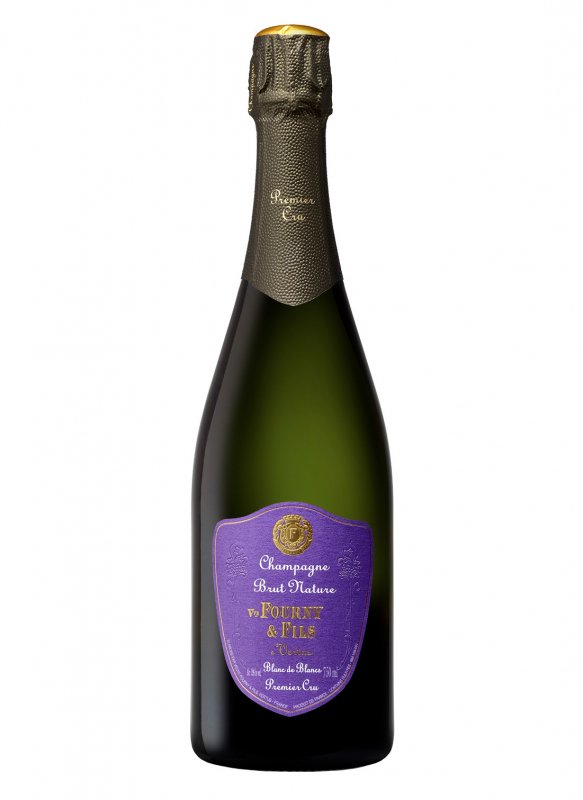
Champagne Veuve Fourny Premier Cru Blanc de Blancs
The Veuve Fourny Premier Cru Blanc de Blancs cuvée from Veuve Fourny & Fils is a 100% Chardonnay champagne classified Premier Cru on the Côte des Blancs. It offers notes of poached pear, acacia blossom and golden brioche, underpinned by forty-eight months of cellar ageing. On the palate, the texture is creamy and the balance precise, making it equally at home as an aperitif or at the dinner table. The Fourny family crafts this intimate, small-batch cuvée across fifteen hectares of chalk soils in Vertus.
Description & Production
The Terroir
The family's vineyards are rooted in Vertus, on the Côte des Blancs. The Chardonnay vines have an average age of forty years. Their root systems reach deep into a subsoil of brown chalk — compacted belemnite rock that absorbs winter rainfall like a sponge.
This chalk releases its water reserves during dry summer periods. The estate practises sustainable viticulture across its fifteen hectares, certified under the Haute Valeur Environnementale label: synthetic herbicides have been eliminated since 2014, and natural grass cover between the rows encourages microbial activity in the soil.
The family's heritage includes the Clos Faubourg de Notre-Dame plot. Its south-easterly aspect ensures even ripening of the grapes. Hand harvesting preserves the integrity of the grape skin all the way to the press.
Winemaking
Pneumatic pressing gently extracts the juice from whole bunches. Only the first-run juice, naturally rich in acidity, is retained. Alcoholic fermentation is initiated by indigenous yeasts (naturally present on the grapes), following a twelve-hour static settling.
Stainless steel tanks are temperature-controlled at 18 °C to preserve aromatic precursors. A portion of the juice undergoes malolactic fermentation in 228-litre oak barrels, adding roundness and body to the base wine.
Lees ageing extends over seven months, maintained by regular stirring (bâtonnage) that keeps the fine lees in suspension. This expertise also benefits a Blanc de Pinots Noirs in the range. Bottling takes place without fining, in the spring following harvest.
Blend Characteristics
The cuvée brings together juice from three successive harvests. Twenty percent reserve wines complement the dominant base year. These aged wines rest in concrete tanks and Austrian oak foudres, whose slight porosity allows the wine to evolve gently over time.
Secondary fermentation in the bottle creates the internal pressure that guarantees a fine effervescence. Lees ageing on lattes in the Vertus cellars spans forty-eight months. This extended contact with the yeasts develops autolytic aromas — brioche, toasted bread, pastry notes — that are characteristic of the house.
Disgorgement removes the sediment without the addition of a dosage liqueur. Where the Extra Brut appellation permits up to 6 g/L, the dosage here is 0 g/L, making this a Brut Nature. The 1.5 L format then slows the wine's evolution prior to release.
Tasting Notes
Appearance
The colour is a pale gold with subtle copper highlights. A particularly fine effervescence forms a steady, persistent and luminous bead against the glass.
Nose
The nose opens with a floral purity of honeysuckle and acacia. The bouquet then reveals aromas of poached pear and yellow citrus. With aeration, hints of toasted brioche round out the whole.
Palate
On the palate, the champagne delivers a silky, full texture. The attack is direct, immediately followed by a lively surge of lemon zest. The finish is very long, trailing off on an intensely saline, chalky note.

Food Pairing Suggestions

- Sea bream sashimi
- Raw salmon sushi
- Cancale flat oysters

- White fish tartare
- Scallop carpaccio
- Turbot poached with yuzu

- Well-aged Chaource
- Young, fruity Comté
- 24-month Parmesan
The Benefits of the Magnum
The magnum holds exactly 1.5 litres of wine, equivalent to twelve 12 cl flutes served as an aperitif. Its neck has the same diameter as a standard 75 cl bottle, meaning the oxygen trapped beneath the cork is distributed across twice the volume.
This favourable ratio limits the wine's oxidative development. The build-up of toasty, roasted notes therefore occurs at a slower pace, and the thermal inertia of the larger format protects the wine from temperature fluctuations.
The Plus de Bulles Expert's View
Why I love it
What strikes me most about this cuvée is its remarkable purity on the nose — refined and elegant throughout. On the palate, I was won over by the creamy profile, perfectly balanced by a wonderful freshness.
My recommendation
Serve this champagne at 8–10 °C in a wine glass. It will be a wonderful companion to aperitifs, sushi and sashimi.
Advice
How to store this champagne?
Plus de Bulles ships this magnum (1.5 L) in reinforced packaging with moulded cellulose inserts designed for the magnum format. Once received, we recommend storing the magnum on its side, away from light — ideally in a cellar, or at least in a cool, not overly dry place with a relatively stable temperature.
Ageing Potential
The Chardonnay from Vertus, naturally high in acidity at harvest, gives this cuvée excellent ageing potential. The Veuve Fourny Premier Cru Blanc de Blancs magnum can be cellared for approximately three to five years.
- Drink now: the aromatic profile delivers the freshness of yellow citrus with hints of acacia.
- After 3 years: the colour deepens slightly as the nose shifts towards toasted brioche.
- After 5 years: the palate structure gains in roundness with the emergence of roasted hazelnut notes.
Serving Suggestions
Optimal serving temperature is between 10 and 11 °C. A fifteen-minute decant encourages the youthful aromas to open up. A tulip glass with a bowl diameter of seven centimetres is recommended: its narrowing opening channels the effervescence towards the tip of the tongue.
A Note on This Cuvée
The clonal selection in the vineyard draws on the heritage of the old vines of Vertus. Emmanuel and Charles-Henri Fourny identify the least productive plants on their estate. This massal selection ensures the genetic diversity of the plant material replanted on their plots. Sorting begins as soon as the pickers move along the rows, excluding any damaged bunches.
This same exacting approach guides the Veuve Fourny library rosé champagne, mellowed by age. The family also produces the Cuvée R in Vertus Chardonnay, sourced from separate old-vine plots.
