
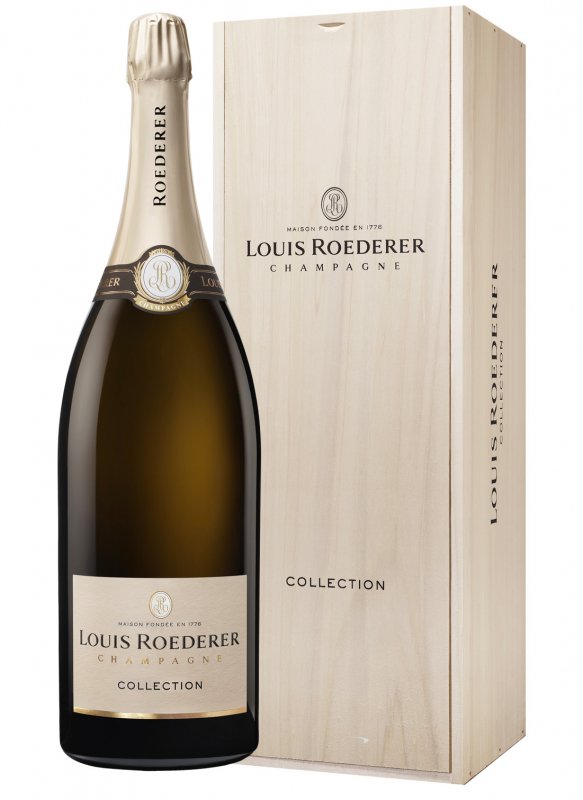
Description & elaboration
The Collection 246 cuvée by Louis Roederer is a non-vintage champagne that offers a precise climatic reading of each harvest. It is a champagne with notes of mirabelle plum and nectarine — candied citrus zests — toasted brioche and roasted hazelnut. On the palate, the powdery, silky texture revolves around an incisive saline freshness.
The Terroir
The grapes come from a strictly balanced distribution across three distinct chalky wine-growing regions. The sun-drenched slopes of the Vallée de la Marne contribute the body of Meunier. The Montagne de Reims, with its Pinot Noir from Verzenay, provides the structure. The Côte des Blancs, and in particular the Campanian chalks of Avize and Mesnil-sur-Oger, deliver their sharp minerality.
The vineyard is certified HVE and VDC, labels overseen by the Comité Champagne. Cover cropping between the rows limits erosion of the sloping chalky soils, while the abandonment of synthetic herbicides preserves local biodiversity. Harvesting is carried out by hand to maintain the integrity of the grapes at picking.
The vinification
Alcoholic fermentation begins at low temperature in temperature-controlled tanks. Malolactic fermentation (the conversion of malic acid into the softer lactic acid) is applied to thirty percent of the volumes, preserving the natural tension of the harvest. Twenty-four percent of the juices ferment directly in oak foudres, contributing vanilla notes and a slight roundness perceptible on serving.
The bottles age forty-eight months on lees. This lengthy autolysis (prolonged contact with dead yeast cells) enriches the texture and develops aromas of brioche and roasted hazelnut.
A non-vintage champagne
The 2021 vintage accounts for fifty-five percent of the total volume, with a harvest conducted from 13 to 30 September. The vintage was marked by a severe spring frost that destroyed a portion of the early buds, followed by summer rains that slowed ripening — significantly reducing yields. A rigorous manual sorting was carried out, setting aside damaged clusters to retain only the desired phenolic ripeness. The extracted juice develops a characteristic saline tension.
The house incorporates a Perpetual Reserve begun during the 2012 harvest, kept in stainless steel tanks away from oxidation, for thirty-five percent of the blend. This stock preserves the aromatic freshness of the reserve wines over the long term. The remaining ten percent comes from wood-aged reserve wines from the 2012 to 2017 campaigns, which bring roundness and depth to the mid-palate.
Tasting notes
Appearance
The appearance of the Collection 246 cuvée is luminous with brilliant highlights. The salmon hue is enriched with shimmering golden nuances. The effervescence unfolds in a sustained bead, with fine bubbles rising slowly to the surface.
Nose
On the nose, one discovers an expressive bouquet of mirabelle plum and nectarine. Stone fruit intertwines with candied citrus zests. Aeration reveals subtle wafts of toasted bread and brioche — the legacy of forty-eight months on lees. A delicate iodine note punctuates the whole, prolonged by touches of roasted hazelnut.
Palate
The attack is silky and fruity, with a powdery, oily texture on the palate. The development reveals an incisive saline freshness, where the acidity integrates harmoniously with the crunchy white peach fruit. The chalky finish lingers on lightly smoky nuances.

Suggested food pairings

- Gougères with aged Comté
- Scallop carpaccio
- Blinis with smoked salmon

- Roasted turbot fillet
- Bresse poularde
- Porcini mushroom risotto

- Aged Chaource
- Thin apple tart
- Salted butter shortbread
The advantages of the jeroboam
This three-litre format is equivalent to four standard bottles, or twenty-four flutes for your gatherings. The XXL size reduces the ratio of trapped oxygen to wine volume, slowing gas exchange with the outside. Ageing thus proceeds with remarkable slowness: yeast autolysis gains in finesse, and aromatic development builds in complexity without compromising freshness. The wooden case underscores the prestige of this piece and ensures safe transport.
The Plus de Bulles expert's opinion
Why I love it?
I was captivated by the powdery, vibrant texture of this cuvée. What truly moves me is its bouquet of yellow fruits and candied citrus, lifted by toasty notes and an iodine finish of remarkable finesse.
My recommendation
Serve at 8–10 °C in a wine glass to allow its delicate texture and yellow fruit aromas to fully blossom.
Advice
How to store this champagne?
Plus de Bulles ships this jeroboam in shock-resistant packaging specially designed for champagne transport. After receipt, store it horizontally, away from light. Ideally in a cellar; alternatively, in a cool, not too dry place at a stable temperature. The wooden case helps protect the jeroboam and stabilise its thermal environment.
Ageing potential
The Collection 246 by Louis Roederer will evolve slowly thanks to the inertia of the jeroboam format, offering a keeping potential of approximately eight to ten years.
- Drink now: the youthful aromas express themselves on yellow citrus notes.
- After 4 years: the profile gains in roundness with autolytic brioche notes.
- After 8 years: tertiary aromas develop with nuances of roasted hazelnut.
Serving suggestions
Plunge the jeroboam into a large basin of water and ice. The thermal inertia of the jeroboam requires at least two hours of chilling. Avoid thermal shock when moving it to the refrigerator. Opt for wide-bowled tulip glasses: the surface area of oxygenation releases the complex aromas and concentrates the fragrant vapours. Fill the glass one third full.
A note about this cuvée
The numbering marks a turning point in Champagne's viticultural history: the figure indicates the two hundred and forty-sixth harvest since 1776, celebrating the estate's unbroken agricultural heritage. To enrich the experience, also discover this gift set including the cuvée and its glasses.
The adaptation to climate reflects the plot-by-plot approach initiated with the legendary vintage cuvée by Roederer. The house has definitively moved away from the former inter-generational standard, now favouring the precise portrait of a singular harvest.

 What customers liked most