
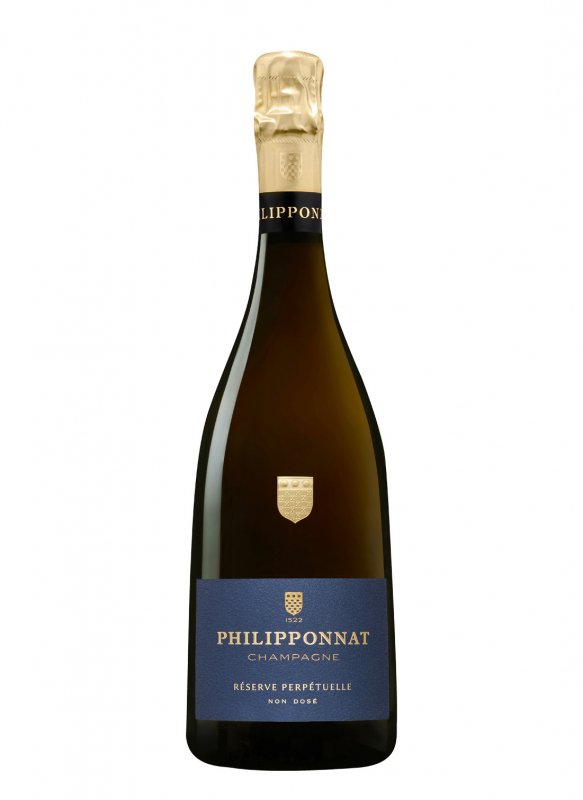
The Philipponnat Perpetual Reserve Non Dosé champagne is a true manifesto of purity. It illustrates the art of perpetual blending, enriched year after year since 1946, and supported by uncompromising winemaking. Its straightforward and vibrant profile, marked by notes of citrus and white flowers, makes it a cuvée of great liveliness. It shines equally well as an aperitif or as an accompaniment to delicate cuisine, particularly Japanese. This is a champagne for discerning connoisseurs in search of authenticity and raw emotion.
The production of Philipponnat's Réserve Perpétuelle Non Dosée champagne
This cuvée is based on a unique philosophy: perpetuating a blend that is constantly evolving. It draws its strength from a subtle balance between youth and maturity, freshness and complexity. The total absence of dosage (0 g/l) gives it a crystalline purity.
The Réserve Perpétuelle Non Dosée cuvée is made from:
- 66% Pinot Noir: the king of Philipponnat's grape varieties, it brings power, vinosity, and a firm structure.
- 32% Chardonnay: it enriches the blend with elegance, freshness, and refined floral notes.
- 2% Pinot Meunier: discreet but effective, it contributes to the fruity balance and roundness on the palate.
The terroir
Most of the grapes come from Grands and Premiers Crus around Mareuil-sur-Aÿ, in the heart of historic Champagne. This terroir in the Marne Valley is characterized by chalky limestone soils, which promote minerality and tension.
Vinification
Philipponnat uses traditional vinification methods, both in vats and oak barrels, in order to preserve aromatic complexity and avoid premature oxidation. Some of the wines from the 2021 harvest (26.8%) did not undergo malolactic fermentation, which preserves their freshness and aging potential. Aging on lees takes place in the house's cool cellars at 12°C for a minimum of three years, well beyond the regulatory 15 months. The absence of dosage enhances the purest expression of the wine.
The vintage and the principle of the perpetual reserve
The Réserve Perpétuelle Non Dosée is not a vintage in the strict sense, but a living blend. Each year, the wines from the new harvest (here 2021) are integrated into some of the blends from previous years, which themselves contain earlier harvests. Thus, this champagne embodies a collective memory of vintages dating back to 1946. This perpetual cycle brings eternal youth, nourished by the freshness of the current year and enriched by the complexity of years past.
Tasting notes
Color
The color of the Réserve Perpétuelle Non Dosée cuvée is a luminous pale gold. Its effervescence is very refined, with a persistent and elegant mousse.
Nose
The nose reveals delicate aromas of white flowers, particularly lime blossom, vine blossom, and hawthorn. This initial floral impression is enhanced by a touch of minerality.
Palate
On the palate, this champagne reveals a clean and pure attack. Citrus notes dominate, offering freshness and liveliness without harshness. The finish is long and clear, marked by nuances of warm bread and fresh apple.

Serving suggestions

- Sea bream sashimi
- Lime salmon tartare
- Fine oysters

- Scallop carpaccio
- Assorted sushi and sashimi
- Sea bass ceviche

- Lemon meringue pie
- Citrus panna cotta
- Yuzu granita
Storage and serving tips
Storing this champagne
To preserve the cuvée's freshness, it is recommended to store it in a cellar at 10-12°C, away from light and vibrations. The bottle should be laid down to keep the cork moist and prevent premature oxidation. A humidity level of around 70% is ideal for optimal aging.
Aging potential
The Réserve Perpétuelle Non Dosée expresses its most vivid brilliance within 6 to 18 months after disgorging. However, it can evolve positively for several years in the cellar, developing more complex and slightly brioche-like notes. In a standard bottle, its aging potential is estimated at between 3 and 5 years, but lovers of more evolved champagnes may wish to keep it longer.
Serving suggestions
This champagne should be served at an ideal temperature of 8°C, cool but not ice-cold. Choose a tulip flute or white wine glass to allow for better aromatic expression. There is no need to decant: its balance is revealed immediately after opening.

 What customers liked most