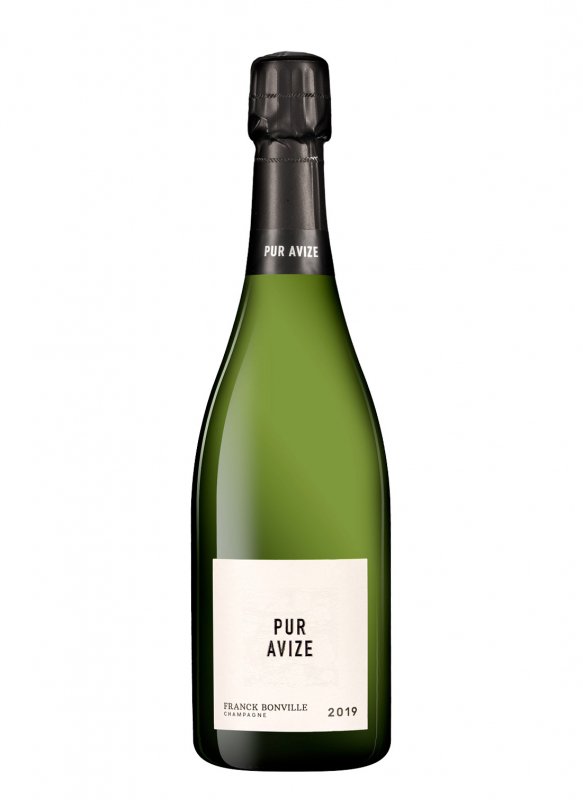
Pur Avize 2019 from Franck Bonville is a Blanc de Blancs champagne, crafted solely from Chardonnay, the signature grape of the Côte des Blancs.
This is a cuvée built around floral notes and citrus, carried by a taut, weightless texture. Serve it as an aperitif, alongside Fine de Claire oysters perhaps, before bringing it to the table with a Sole meunière.
A true expression of terroir, this cuvée seeks to fully reveal Avize, its home Grand Cru, and the particularities the House has been mastering for decades.
The Terroir
Pur Avize 2019 is a Blanc de Blancs, meaning it is made entirely from Chardonnay.
The Chardonnay comes from the terroir of Avize, a village classified as Grand Cru on the Côte des Blancs, where Franck Bonville tends its vines. The blend brings together three plots at the heart of Avize's terroir, which encircle the village and offer a faithful, house-defining expression of it.
The deep, free-draining chalk subsoil gives the wine its tension and precision on the palate, while the accompanying limestone feeds the vines with minerals that come through as a persistent saline edge.
On this terroir, Chardonnay lends the wine precision and pure fruit character.
Winemaking
Olivier Bonville, the winemaker at the helm of Maison Franck Bonville, chose to age this 2019 Chardonnay entirely in stainless steel tanks, to preserve the purity of the fruit without adding oak-driven notes. Malolactic fermentation was carried through in full, rounding out the acidity and lending a velvety mouthfeel. The wine was then bottled under cork for its secondary fermentation.
Dosage sits at 3.3 g/L, an extremely low dosage that places this cuvée in the Extra Brut category: it allows the Chardonnay's tension to shine through unmasked, for a clean, precise finish. At Franck Bonville, this precision in the winemaking defines the House's entire style.
The 2019 Vintage
In Avize, 2019 began under the sign of cold weather: a spring frost affected part of the village's buds, and flowering of the early-ripening Chardonnay struggled through to mid-June. Summer then swung to the opposite extreme, with a late-July heat spike that accelerated sugar accumulation in the grapes. A luminous September, with cool nights, allowed for a steadier ripening period and preserved acidity. The late harvest thus delivered grapes with a rare balance of sugar and freshness, despite lower yields. This contrast shaped a cuvée that is both taut and generous on the palate, the signature of an exceptional vintage for this terroir.