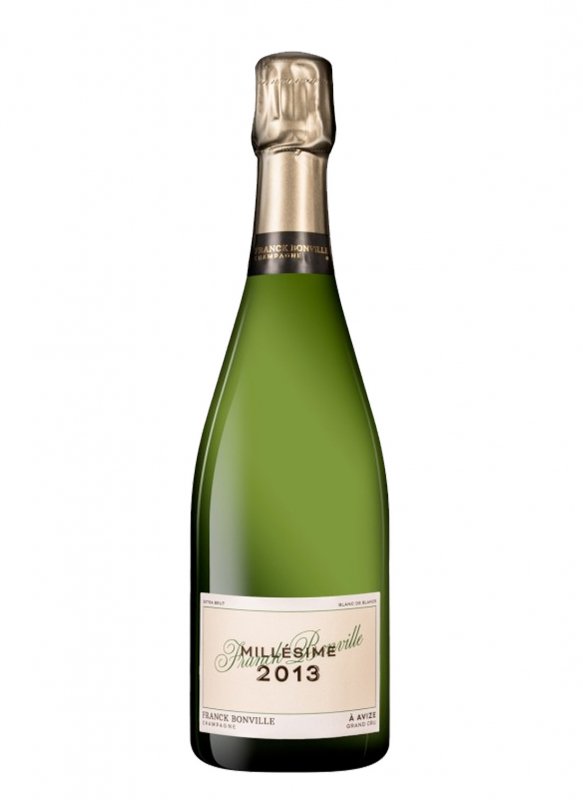
The Millésime 2013 Retrouvé, crafted by Franck Bonville, is a Blanc de Blancs champagne. It is made exclusively from Chardonnay, the House's signature grape.
From the very first glass, this cuvée speaks of citrus and white orchard fruit, lifted by a delicate floral touch. Its taut, mineral-driven texture gives it real backbone and remarkable freshness.
This is a bottle you can pour as an aperitif, alongside parmesan shortbread for instance, before bringing it to the table with turbot in hollandaise sauce, letting the pleasure carry on right through the meal.
The Terroir
The Millésime 2013 Retrouvé is a Blanc de Blancs, meaning it is made solely from Chardonnay.
The Chardonnay comes from the Côte des Blancs, a Grand Cru-classified area of Champagne where Franck Bonville tends his vines.
The subsoil here is deep chalk, a rock that drains away excess water and forces the vines to dig deep for their resources, giving the wine its tension and precision. Chalk also retains a natural coolness that translates into a saline minerality on the palate.
On this terroir, Chardonnay lends the wine its vibrancy and its clean, upright character.
Winemaking
Olivier Bonville, the winemaker at the helm of Maison Franck Bonville, chose to ferment this 2013 Chardonnay entirely in stainless steel tanks, a vessel that preserves the purity of the fruit without adding any woody notes. Malolactic fermentation was carried through in full, softening the grape's natural acidity and lending the wine a velvety mouthfeel.
The dosage, in the Brut category, then fine-tunes the wine's balance without ever masking its underlying tension. This choice allows the honest, true-to-variety aromas to shine through, with no sweetness getting in the way.
At Franck Bonville, every step of the process serves a single purpose: giving this 2013 vintage the clarity and precision that are the House's hallmark.
The 2013 Vintage
In the Côte des Blancs, 2013 opened with a cool, damp spring that delayed budbreak by several weeks. A relatively wet autumn in 2012 had kept the foliage healthy, allowing the vines to build up good reserves in the wood, and a sharp, cold winter gave way to a cool spring whose frosts spared the late-budding vines. Summer began beautifully, with full flowering in early July, then continued warm and dry, though punctuated by the occasional storm. Despite this, the vines never quite made up the lost time and ripening progressed relatively slowly, making for a tricky harvest once the weather turned in autumn. Even so, the Côte des Blancs enjoyed relatively dry harvest conditions, and the Chardonnay, picked first, was the real winner of this Indian summer. This slow ripening and the freshness it preserved give the wine its tension and its saline, upright character, the signature of this patient vintage.