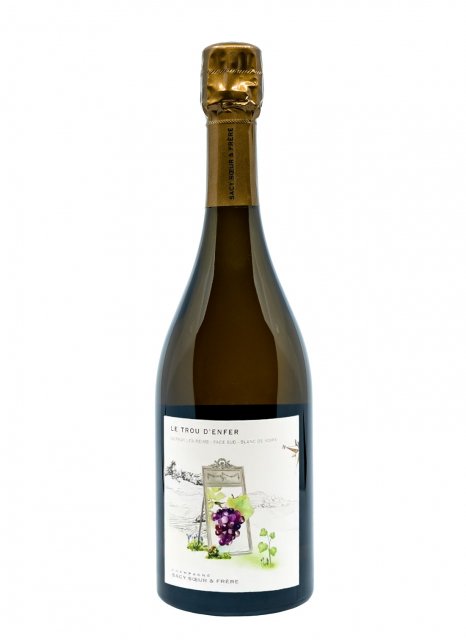


Le Trou d'Enfer 2023 FACE SUD, made by Domaine Sacy Soeur et Frère, is a vintage champagne, meaning every grape in the blend comes from a single harvest.
It speaks of red and white fruit with a crisp, crunchy freshness, while the texture is vinous and round.
Pour it as an aperitif with comté gougères, say, then bring it back to the table alongside a roast Bresse chicken. Just 3,300 bottles of this cuvée were produced.
The Terroir
Le Trou d'Enfer 2023 FACE SUD is a Blanc de Noirs, made entirely from Pinot Noir.
The grapes come from the Montagne de Reims, where Domaine Sacy Soeur et Frère farms its vines.
Le Trou d'Enfer is a south-facing parcel, turned squarely towards the sun, so the vines enjoy maximum exposure. This aspect (the orientation of the slope relative to the sun) brings the grapes to full ripeness, giving the wine roundness and warmth on the palate, with ripe fruit rather than sharp, racy notes. Where a north-facing site would preserve freshness, the south embraces generosity.
On this terroir, Pinot Noir lends the wine structure and depth.
The Winemaking
Jonathan Sacy, the grower, chose to vinify this 2023 Pinot Noir in stainless steel tank. This neutral vessel adds no oak character: it lets the grape speak and preserves a clean fruit profile, bright with precision and purity.
He then allowed malolactic fermentation to run its full course (the conversion of sharp acidity, reminiscent of green apple, into a softer acidity closer to that of milk). It rounds off the acidity and brings a silky texture to the palate.
The wine was bottled for its second fermentation, the one that creates the bubbles, and 3,300 bottles were filled. Once the fizz had developed, the sediment it leaves behind was removed (disgorgement) in April 2026.
The 2023 Vintage
In the Montagne de Reims, 2023 was a season of contrasts. A very wet spring replenished soils left thirsty by the winter, and the summer that followed stayed rather muted. A heatwave then marked the start of September: this harvest was among the hottest ever recorded in Champagne. The heat concentrated the berries, Pinot Noir in particular. Acidity (which gives the wine its vivacity) held up well and kept the grapes in balance. The resulting style combines generosity with grip: this cuvée shows ripe, concentrated fruit with a roundness that the grapes' freshness keeps buoyant.