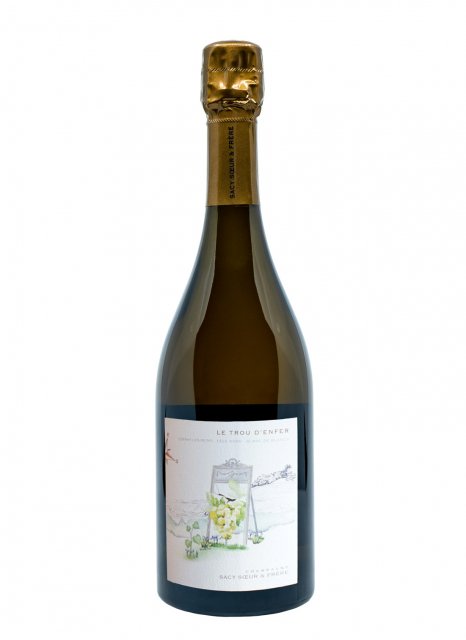


The Le Trou d'Enfer 2023 FACE NORD cuvée from Domaine Sacy Soeur et Frère is a vintage champagne.
It is a cuvée built around citrus and white fruit, lifted by a touch of white blossom. The texture is well balanced, carried by a mineral tension (a clean freshness that shapes the wine from start to finish). The fruit stays crisp and fresh.
This is a bottle you can pour as an aperitif, with Fines de Claire oysters for instance, then bring back to the table alongside a Dover sole meunière. Only 5,000 bottles were produced.
The Terroir
The Le Trou d'Enfer 2023 FACE NORD cuvée is a Blanc de Blancs, meaning it is made exclusively from Chardonnay.
The Chardonnay comes from the Montagne de Reims, where Domaine Sacy Soeur et Frère tends its vines.
The vines of the Trou d'Enfer parcel face north: they receive less direct sunshine, which preserves the freshness and brightness of the grapes as they ripen. The clay-sand soil works in two ways. The clay holds water and releases it gradually to the vine, even in dry weather, giving roundness on the palate. The sand, light and free-draining, keeps the wine from becoming heavy and lends it finesse.
On this terroir, Chardonnay brings elegance and precision to the wine.
The Vinification
Jonathan Sacy, the winemaker at the helm of Sacy Soeur et Frère, chose to ferment this 2023 Chardonnay in stainless steel tank. The vessel adds no oak character: it lets the fruit speak for itself and preserves a vivid, very linear freshness.
The wine then went through malolactic fermentation, taken all the way to completion (this second transformation converts the grape's sharp acidity into a softer one). It rounds off the edges and brings a silkiness you can feel from the very first sip, a counterpoint to the tension that the steel provides.
The sediment that formed in the bottle was removed in April 2026 (the disgorgement), the final step before the wine is ready to be served at your table.
The 2023 Vintage
On the Montagne de Reims, 2023 was a year of shifting moods. After a hot, dry 2022, a very mild and rainy March woke the vines early. Véraison (the point at which the grapes begin to ripen) came around 19 August, in line with the average of the past ten years, and picking started in the very first days of September. The bunches, plentiful and heavy, produced very healthy Chardonnay. Sugar levels peaked despite modest potential alcohol. This "bittersweet" year, as the trade describes it, gives the cuvée a clean fruit character and a precise freshness.