


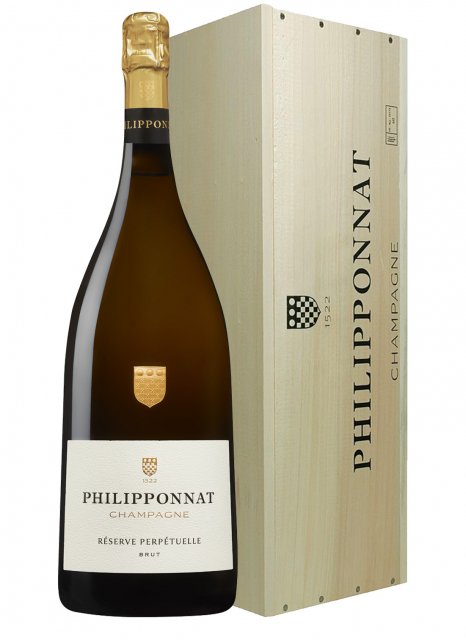
Philipponnat
Réserve Perpétuelle Brut | Jeroboam 300cl - Wooden case
The Réserve Perpétuelle Brut cuvée from Philipponnat is a champagne drawn primarily from vineyards in Mareuil-sur-Aÿ and Aÿ, in the Vallée de la Marne. It is a champagne with notes of linden blossom, raspberry and toasted bread, with a vinous and fleshy texture on the palate. It pairs naturally with lunch or roast poultry. This jeroboam is the fruit of the work carried out by Charles
Order today and receive your parcel the Monday, September 14, 2026 by Chronopost.

All our champagnes are stored at controlled temperature

From 10,99 £GB in France and 9,99 £GB in Europe. Delivery in Relais Parcel offered soon

By Visa, MasterCard and Bank transfer

Leave a little message in your package

Description
Description & elaboration
The Réserve Perpétuelle Brut cuvée from Philipponnat is a champagne drawn primarily from vineyards in Mareuil-sur-Aÿ and Aÿ, in the Vallée de la Marne. It is a champagne with notes of linden blossom, raspberry and toasted bread, with a vinous and fleshy texture on the palate. It pairs naturally with lunch or roast poultry. This jeroboam is the fruit of the work carried out by Charles Philipponnat at a House whose roots stretch back to 1522, a rare living witness to the history of Champagne.
Presented in a jeroboam (3L), this champagne is based on the solera principle (a perpetual reserve system blending the musts of a harvest with reserve wines kept in casks), ensuring gustative continuity from one year to the next.
The Terroir
The blend includes 66% Grands Crus and Premiers Crus sourced from Mareuil-sur-Aÿ, notably the lieu-dit Le Léon, as well as from Aÿ, Mutigny and Avenay-Val-d'Or. The Pinot Noir vines are planted in clay-limestone and chalk soils dating from the Campanian period, forcing the roots to reach deep into the ground. This chalky subsoil, typical of the region's historic terroirs, generates a mineral tension that balances the richness of the Pinot Noir. The southerly exposure encourages full ripeness before harvest.
The winemaking
The winery works exclusively with cuvée musts from the first pressing. Fermentation of the still wines (juices destined for blending before the second fermentation) takes place at a controlled temperature of around 18 °C. The final blend comprises 66% Pinot Noir, 32% Chardonnay and 2% Meunier. Malolactic fermentation (the conversion of sharp malic acid into softer lactic acid) is blocked for 27% of the volumes, preserving the structural freshness of the cuvée.
The elaboration incorporates 56% reserve wines aged in French oak barrels. The porosity of the wood gradually imparts tertiary complexity to the profile. At disgorgement, the cuvée receives a dosage liqueur prepared from these same reserve wines, achieving a Brut dosage of 8 g/L and an alcohol level close to 12 degrees, contrasting with the Extra-Brut versions in the range. The jeroboam ages on laths for 36 months. The disgorgement date is shown on the back label of the jeroboam.
The base harvest
The current edition is built around recent harvests, selected to maintain the consistency of the House style with a beautiful freshness. The plots yielded qualitative and well-balanced grapes, delivering juices with a marked natural acidity. Pinot Noir provided concentrated musts, while Chardonnay preserved its citrus aromas.
These base-year juices are then incorporated into the estate's perpetual reserve. These solera wines account for more than half of the bottled volume. This annual fractioning allows older vintages to impart their character to the younger wines, ensuring the stylistic continuity of the House.
Tasting notes
Appearance
The colour presents a deep gold hue with amber highlights, enlivened by a slow stream of fine bubbles rising to the surface.
Nose
On the nose, one discovers notes of vine blossom and linden, which quickly evolve with aeration towards aromas of toasted bread, red fruits and honey.
Palate
On the palate, this champagne opens with a vinous attack, driven by aromas of raspberry and redcurrant, before extending into a biscuity, chalky finish.

Food pairing suggestions

- Foie gras toasts
- Gougères with aged Comté
- Smoked salmon verrines

- Bresse chicken
- Braised veal sweetbreads
- Turbot with hollandaise sauce

- Aged farmhouse Chaource
- Beaufort d'alpage
- Mirabelle plum tart
The benefits of the jeroboam
The jeroboam holds three litres, the equivalent of 24 flutes. This format reduces the ratio between the oxygen present under the cork and the volume of wine. Air penetrates more slowly, extending the ageing potential of the cuvée over the years. This bottle is shipped in a bespoke individual wooden case, a format perfectly suited to gifting on a special occasion.
The Plus de Bulles expert's opinion
Why I love it
What strikes me about this cuvée is its vinous, full-bodied attack. I loved its bouquet of fresh toasted bread evolving towards notes of redcurrant and honey, offering a broad palate with a beautiful, lingering finish.
My recommendation
Serve at 8 °C in a wine glass alongside poultry or fish. It will drink beautifully through to 2033.
Tips & advice
How to store this champagne?
Plus de Bulles ships this jeroboam (3L) in reinforced transit cartons specially designed for champagne. Upon receipt, we recommend storing the jeroboam on its side, away from light — ideally in a cellar, or at the very least in a cool, not overly dry location with a relatively stable temperature. The accompanying wooden case provides thermal insulation and protects the wine from sudden temperature fluctuations during storage.
Ageing potential
The Réserve Perpétuelle Brut from Philipponnat can develop in the bottle over a period of three to five years. This champagne is ready to drink now, but will reward a few years of cellaring.
- Drinking now: the champagne showcases the acidity of the base harvest with notes of crisp raspberry.
- After 3 years: autolysis (the breakdown of yeasts after ageing on lees) releases aromas of toasted bread and pastry notes.
- After 5 years: maturation under cork reveals notes of spice, honey and biscuit.
Serving suggestions
To fully appreciate its vinosity, this jeroboam calls for a serving temperature of 8 to 10 °C. Tulip-shaped glasses encourage aeration of the cuvée and concentrate the aromas of the Pinot Noir.
An anecdote about this cuvée
The origins of this reserve date back to 1946, when the House initiated its perpetual conservation technique. By retaining a proportion of the annual blend to incorporate into the following harvest, Charles Philipponnat has sustained the continuity of his cellars. Ageing in casks imparts a greater complexity to the wine than the iconic Royale Réserve Brut cuvée, an approach modelled on the winemaking of the Clos des Goisses.
Also worth discovering: the structure of the vintage Blanc de Noirs.
Characteristics
Terroirs
Grape varieties
Pinot Noir (66%)Chardonnay (32%)Pinot Meunier (2%)
Terroirs
Montagne de ReimsCôte des blancsVallée de la MarneMareuil-sur-AyAÿ
Winemaking
Couleur:
Non vintage
Oak aged
Partially oak aged
Malolactic Fermentation :
Undergone
Dosage:
Brut (between 6 and 12 gr/l)
Tasting
Aromas
FloralFruityFresh
Pairings
Serve as an aperitif or at the beginning of a meal
Serving température
8°C
Tasting window
 20262029
(Best)2033
FAQ
The price of the Philipponnat Réserve Perpétuelle Brut is 299,95 £GB. This cuvée benefits from a perpetual reserve process that began in 1946 and is partially aged in oak barrels. It contains 56% reserve wines.
Fans of this Champagne house highlight the wine’s rich, fruity character and its biscuity finish. Discover what our customers have to say in the dedicated section: Reviews of Philipponnat’s Réserve Perpétuelle Brut.
Decanting the Philipponnat Réserve Perpétuelle Brut is not necessary. However, decanting it for thirty minutes helps wines aged in oak reveal their notes of honey and toast before serving in tulip-shaped glasses.
Philipponnat Réserve Perpétuelle Brut is crafted to accompany a meal. Its Pinot Noir base (66%) and full-bodied texture make it an ideal choice for lunches featuring white meats, such as Bresse chicken with morel mushrooms or sweetbreads.
No, Philipponnat Réserve Perpétuelle Brut is a non-vintage champagne. The blend is based on recent harvests and includes 56% reserve wines aged in a solera system. The disgorgement date is always indicated on the back label.
The difference lies in the blend. Philipponnat's Réserve Perpétuelle Brut includes 32% Chardonnay and 2% Meunier to soften the cuvée. The Blanc de Noirs derives its character exclusively from the vinification of black grapes grown on plots in the Marne Valley.
Starred tables
 Guy Savoy (Paris) Pierre Gagnaire (Paris) Michel Bras (Laguiole) Pic (Valence) Le Petit Nice (Marseille) Auberge du Vieux Puits (Fontjoncouse) La Bouitte (Saint-Martin-de-Belleville) Arpège - Alain Passard (Paris) Maison Lameloise (Chagny) Régis et Jacques Marcon (Saint-Bonnet-Le-Froid) Plaza Athénée - Alain Ducasse (Paris) Pavillon Ledoyen - Yannick Alléno (Paris) L'Astrance (Paris) Arpège (Paris) Epicure au Bristol (Paris) L'Assiette Champenoise (Reims) Alexandre (Garons) Michel Sarran (Toulouse) Le Puits Saint-Jacques (Pujaudran) L'Oasis (Mandelieu-La-Napoule) L'Oustau de Baumanière (Les-Beaux-de-Provence) Les Cèdres (Granges-les-Beaumont) Mère Brazier (Lyon) L'Atelier d'Edmond (Val d'Isère) Le Bateau Ivre (Le-Bourget-du-Lac) La Bastide de Capelongue (Bonnieux) Christopher Coutanceau (La Rochelle) La Grand'Vigne (Martillac) La Grande Maison de Bernard Magrez (Bordeaux) Le Pressoir d'Argent - Gordon Ramsay (Bordeaux) Carré des Feuillants (Paris) Maison Rostang (Paris) Le Meurice - Alain Ducasse (Paris) Le Taillevent (Paris) Les Crayères (Reims) Meurin (Busnes)
 Customer reviews
| 65% | (40) | ||
| 29% | (18) | ||
| 7% | (4) | ||
| 0% | (0) | ||
| 0% | (0) | ||
| 0% | (0) |
Reviews of this cuvee
- December 5, 2024Cédric T.Réserve Perpétuelle Brut - box - bottle 75cl
- October 12, 2024Daniel S.Réserve Perpétuelle Brut - nu - bottle 75cl
- October 11, 2024Jeanine J.Réserve Perpétuelle Brut - nu - bottle 75cl
- December 29, 2022ROBERT F.Réserve Perpétuelle Brut - box - bottle 75cl
- September 22, 2022Chantal v.Réserve Perpétuelle Brut - box - bottle 75cl
- July 10, 2022Peter A.Réserve Perpétuelle Brut - box - bottle 75cl
- May 23, 2022Nicolas G.Royale Réserve (coffret Deluxe) - presentation pack + flutes - bottle 75cl
- May 21, 2022Alexandre M.Réserve Perpétuelle Brut - box - bottle 75cl
- April 21, 2022Alexandre M.Réserve Perpétuelle Brut - box - bottle 75cl
- March 8, 2022Nicolas G.Royale Réserve (coffret Deluxe) - presentation pack + flutes - bottle 75cl
- February 10, 2022Michel R.Réserve Perpétuelle Brut - box - bottle 75cl
- December 27, 2021El M.Royale Réserve - presentation pack + flutes - bottle 75cl
- December 10, 2021Colette l.Réserve Perpétuelle Brut - box - bottle 75cl
- December 7, 2021Stéphane g.Réserve Perpétuelle Brut - box - bottle 75cl
- October 5, 2021Lionel M.Réserve Perpétuelle Brut - box - bottle 75cl
- September 21, 2021Eric M.Réserve Perpétuelle Brut - box - bottle 75cl
- August 30, 2021Guy S.Réserve Perpétuelle Brut - box - bottle 75cl
- August 25, 2021MAUBERT S.Réserve Perpétuelle Brut - box - bottle 75cl
- July 13, 2021Jérôme I.Réserve Perpétuelle Brut - box - bottle 75cl
- June 25, 2021Roberto C.Royale Réserve - box - magnum 150cl
- June 25, 2021Roberto C.Réserve Perpétuelle Brut - box - bottle 75cl
- May 27, 2021Marco M.Réserve Perpétuelle Brut - box - bottle 75cl
- May 27, 2021Reiner F.Réserve Perpétuelle Brut - box - bottle 75cl
- December 26, 2020Tiphanie J.Royale Réserve - presentation pack + flutes - bottle 75cl
- December 20, 2020PASCAL D.Réserve Perpétuelle Brut - box - bottle 75cl
- December 12, 2020Daniel p.Réserve Perpétuelle Brut - box - bottle 75cl
- December 12, 2020Julien P.Réserve Perpétuelle Brut - box - bottle 75cl
- December 12, 2020Jean-Pierre S.Réserve Perpétuelle Brut - box - bottle 75cl
- November 19, 2020MURIEL D.Royale Réserve - presentation pack + flutes - bottle 75cl
- November 3, 2020Catherine P.Réserve Perpétuelle Brut - box - bottle 75cl
- October 27, 2020Mailfert C.Réserve Perpétuelle Brut - box - bottle 75cl
- July 18, 2020MURIEL D.Royale Réserve - presentation pack + flutes - bottle 75cl
- June 28, 2020Nicolas Z.Réserve Perpétuelle Brut - box - bottle 75cl
- June 27, 2020Nicolas D.Royale Réserve - box - magnum 150cl
- June 6, 2020Roberto C.Royale Réserve - box - magnum 150cl
- June 6, 2020Roberto C.Réserve Perpétuelle Brut - box - bottle 75cl
- May 10, 2020Pietrocarlo T.Royale Réserve - box - magnum 150cl
- May 10, 2020Pietrocarlo T.Réserve Perpétuelle Brut - box - bottle 75cl
- January 12, 2020MI R.Réserve Perpétuelle Brut - box - bottle 75cl
- December 25, 2019Florence d.Réserve Perpétuelle Brut - box - bottle 75cl
- August 28, 2019ALAIN C.Réserve Perpétuelle Brut - box - bottle 75cl
- August 2, 2019Domenico v.Réserve Perpétuelle Brut - box - bottle 75cl
- July 2, 2019Richard P.Réserve Perpétuelle Brut - box - bottle 75cl
- June 29, 2019SONIA B.Réserve Perpétuelle Brut - box - bottle 75cl
- June 24, 2019Guillaume A.Réserve Perpétuelle Brut - box - bottle 75cl
- December 15, 2018Philippe G.Royale Réserve - box - magnum 150cl
- December 3, 2018Jacques S.Réserve Perpétuelle Brut - box - bottle 75cl
- November 19, 2018Olivier X.Réserve Perpétuelle Brut - box - bottle 75cl
- September 4, 2018Romain U.Réserve Perpétuelle Brut - box - bottle 75cl
- August 26, 2018Pierre L.Royale Réserve - box - magnum 150cl
Philipponnat Réserve Perpétuelle Brut : good to know
| 📦 Packaging | Champagne in a wooden case |
|---|---|
| 🍾 Format | Jeroboam |
| 📍 Terroirs | Montagne de reims , Cote des blancs , Vallée de la marne |
| ↕️ Dosage | Champagne brut |
| ⏳ Wine ageing | Champagne partially vinified in oak barrels |
| 🔎 Malolactic fermentation | Undergone |
| 🎨 Colour | White champagne |
| ⭐ Vintage | Non vintage champagne |
| 🍇 Cépage | Pinot noir , Pinot meunier , Chardonnay |
Opinion of thewine guides