


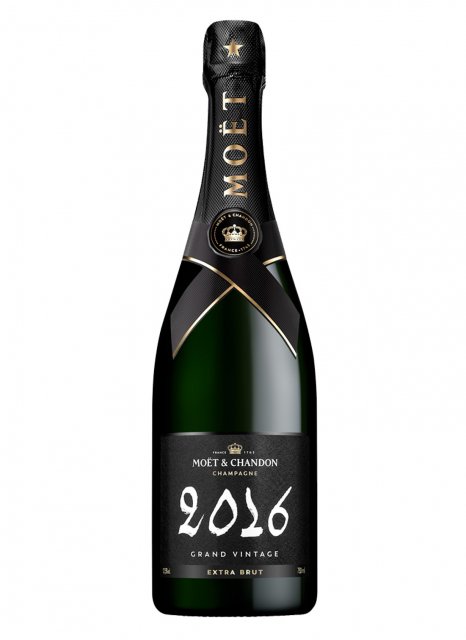


Description & elaboration
The Grand Vintage 2016 cuvée from Moët & Chandon is an Extra Brut champagne marking the seventy-seventh vintage produced by this House, founded in Épernay in 1743. It is a champagne with notes of toasted cereals — mirabelle plum — and marzipan, underpinned by a mineral tension characteristic of this late harvest. On the palate, the texture is fluid and mouth-watering, with a fresh and lightly saline finish. A rare edition, crafted by cellar master Benoît Gouez from a rigorous selection of the finest plots of the year.
The Terroir
The Champagne vineyards used for this cuvée rest on chalky subsoils formed during the Campanian era. The chalk acts as a natural water regulator, retaining winter rainfall and releasing it through capillary action to the roots during summer. The grapes are sourced from a selection of Grands Crus and Premiers Crus, including notably Chouilly, Cramant and Aÿ.
The hillside vineyards benefit from a south and south-east exposure with an average slope of 15%, offering better grape maturity. The vine roots reach deep into the limestone, imparting the wine's characteristic mineral signature.
The structure contributed by the black grape varieties evokes the architecture of a Blanc de Pinots Noirs. Champagne Chardonnay brings tension and freshness to the blend, while Pinot Meunier completes its aromatic framework.
The winemaking
The hand-harvested grapes are pressed in fractions to isolate the primary juice. Alcoholic fermentation takes place in temperature-controlled stainless steel tanks at 18 °C, preserving the aromatic finesse of the juices.
Malolactic fermentation is carried out, softening the natural acidity of the harvest. Ageing on lees lasts approximately eighty-four months: this extended time in the cellar develops the brioche, toasted bread and marzipan aromas characteristic of this cuvée.
The 2016 vintage
The growing cycle began with a mild winter, followed by a spring marked by late frost episodes in April. May and June recorded rainfall exceeding the ten-year averages, generating significant disease pressure on the foliage.
The climate shifted in mid-July towards a prolonged summer drought. Temperatures reached heatwave levels in August, temporarily slowing the véraison of the bunches. Early September showers relaunched ripening at the last moment, bringing richness and concentration to the berries.
Harvest began on 15 September under dry atmospheric conditions. The extracted juices revealed a remarkable balance between sugar concentration and preserved acidity.
Tasting Notes
Appearance
The colour presents a pale yellow hue with brilliant silver highlights. Fine bubbles rise in regular columns from the base of the glass, feeding a continuous ring along the side.
Nose
The olfactory approach opens with delicate notes of toasted cereals. The bouquet then unfolds aromas of mirabelle plum, marzipan and almond paste, reflecting the eighty-four months of lees ageing. Aeration reveals a delicate hint of orange blossom in the background.
Palate
The attack is fruity and remarkably fluid. The texture coats the palate with great delicacy and without heaviness. The finish extends the tasting experience with the zesty freshness of white pomelo, punctuated by a persistent saline note.

Food Pairing Suggestions

- Comté gougères
- Toasted hazelnuts
- Smoked salmon blinis

- Seared scallops
- Braised veal sweetbreads
- Roasted sea bass with fennel

- Comté aged 18 months
- Mirabelle plum tart
- Farmhouse Chaource
The advantages of the 150cl magnum
The 150 centilitre magnum corresponds to the standard format of the AOC Champagne appellation. This volume allows for 12 flutes filled to twelve centilitres. The cylindrical natural cork stopper ensures an airtight seal while allowing very slight gas exchange, which favours the slow evolution of the wine.
The Plus de Bulles expert's opinion
Why I love it
This vintage won me over with its perfect balance between the roundness of its brioche notes and the tension of its finish. I particularly appreciate its delicate bubble, which lingers with a zesty citrus peel freshness.
My advice
Serve at 8–10 °C in a wine glass to accompany a fine fish dish, or wait a few more years in the cellar.
The decision to single out this harvest reflects the House's tasting committee's rigorous analysis of the musts. The absence of reserve wines obliges the cuvée to find its balance solely within the 2016 harvest — something that the extended time in the cellar, eighty-four months on lees, makes possible. The Extra Brut profile allows the purity of the selected terroirs to express itself fully.
Advice
How to store this champagne?
Plus de Bulles ships this magnum (150 cl) in reinforced packaging specially designed for champagne transport. Upon receipt, we recommend storing the magnum on its side, away from light — ideally in a cellar, or at the very least in a cool, not too dry location with a relatively stable temperature.
Ageing potential
The Grand Vintage 2016 from Moët & Chandon offers a beautiful capacity for evolution, with a cellaring potential of approximately ten to twelve years from the date of purchase.
- Until 2026: freshness dominates, with clean aromas of white fruits and citrus.
- From 2027: time brings indulgent notes of toasted brioche and candied fruits.
- Around 2035: over the years, roasted, spiced and woodland accents emerge.
Serving suggestions
Chilling is best achieved by immersion in iced water for thirty minutes. A tulip-shaped glass concentrates the aromas thanks to its narrowed rim. Pouring in two stages limits overflow when serving.
The low-dosage profile of this cuvée is best served between 10 and 11 °C: a slightly lower temperature would mask the toasted bread notes developed through the extended lees ageing.
A note about this cuvée
The blending team describes this edition as the reflection of a restorative autumn following a chaotic climatic journey. The documentation of this viticultural adaptation is regularly monitored by the Union des Maisons de Champagne. This vintage offers a valuable insight into climatic variations between decades.
You can then compare this cuvée with the great vintage from Moët of the previous year. The Chardonnay backbone of this blend also evokes the architecture of a prestigious blanc de blancs prestige cuvée.

Opinion of thewine guides