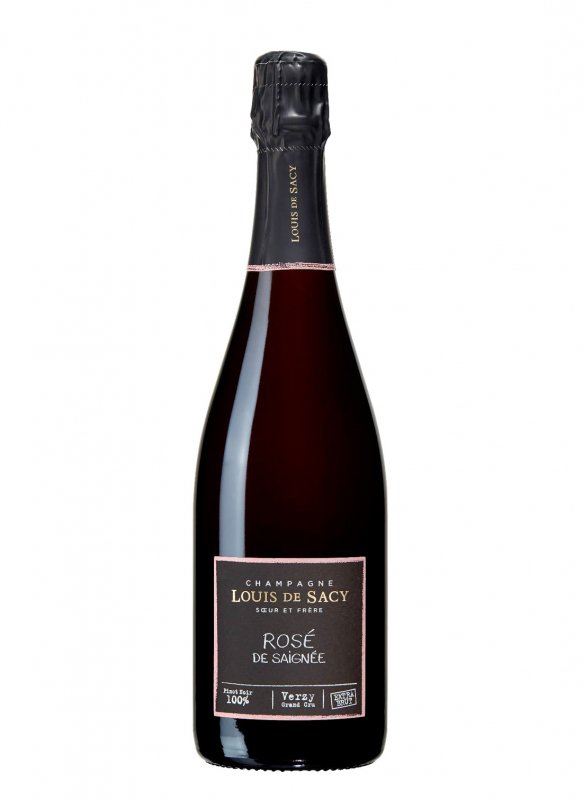
The Rosé de Saignée cuvée crafted by Louis de Sacy is a champagne made using the saignée method. The juice macerates with Pinot Noir skins to capture its colour. It brings together the terroir of the village of Verzy and the Buissons plot, planted with 50-year-old vines harvested by hand.
This rosé speaks of crisp red fruit, lifted by a spicy edge, underpinned by a round, wine-rich palate. It's a cuvée you can serve from the aperitif onwards, with salmon rillettes for example, before carrying it through to the table alongside a roasted duck breast.
Only 3,900 bottles of this cuvée were produced, a mark of its rarity.
Le Terroir
The Rosé de Saignée cuvée is a Blanc de Noirs, meaning it is made solely from Pinot Noir.
These Pinot Noir grapes come from the Montagne de Reims, classified Grand Cru, where Louis de Sacy tends its vines.
In this terroir, the chalky subsoil holds water deep down and releases it steadily to the vines, giving the wine its characteristic tension. The limestone at the surface feeds the roots with minerals that come through as a touch of salinity on the finish. This combination shapes grapes that are both ripe and vivid, carrying real depth without ever losing precision.
In this terroir, Pinot Noir lends the wine its fleshy structure and deep colour, characteristic of this rosé-making method.
La vinification
Jonathan Sacy, the winemaker at the helm of Maison Louis de Sacy, chose to vinify this saignée Pinot Noir entirely in stainless steel tanks, to preserve the purity of the fruit without any oaky notes. Malolactic fermentation was carried through in full: it softens the Pinot Noir's natural acidity and brings a velvety texture to the palate. This winemaking choice gives the wine a rounded character, far from the biting tension that other winemakers seek out.
As for dosage, this cuvée is non dosé: classified as Brut Nature, it receives no sugar adjustment after disgorgement. The result is a rosé of frank, honest character, where the Pinot Noir's red fruit flavours come through unfiltered and unsoftened. This rigour in the winemaking is the signature of Louis de Sacy: a rosé de saignée shaped by clear-cut decisions, crafted by Jonathan Sacy as a faithful reflection of the grape.
Une cuvée non millésimée
The harvests that make up this cuvée carry no single vintage year: Louis de Sacy blends several harvests, folding in reserve wines kept in the cellar with each batch. This approach smooths out the variations from one year to the next and delivers, year after year, the same style of Rosé de Saignée. For a non-vintage cuvée like this one, it's this consistency that takes precedence over the singularity of any one summer: each bottle thus carries the House's own distinct character, regardless of the ups and downs of any single harvest. It is precisely this blending work, carried out across several years of harvests in the Montagne de Reims, that guarantees the consistency and fidelity of the aromatic profile that admirers of this cuvée have come to expect.