
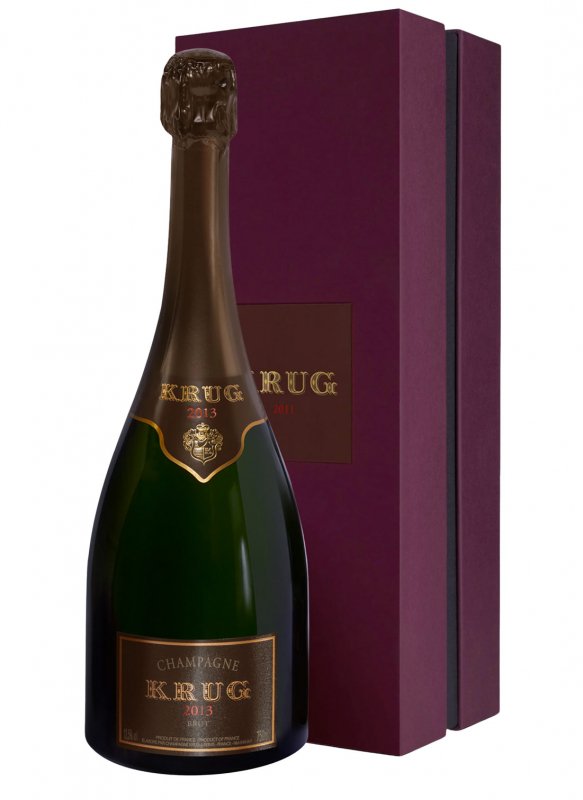
The Krug Vintage 2013 is a champagne that is at once fruity, briny, and remarkably lively. Its characteristic tension stems from an atypical year in Champagne, with a growing season that extended into the fall. It is this natural slowness that forges the acidity and concentrates the body. It is a cuvée that shines equally well as an aperitif or paired with fine white fish.
The bottle features the Krug iD system via a six-digit code printed on the back label, tracing the wine’s origins.
The production of Krug Vintage 2013
The Terroir
The Cretaceous chalk, ubiquitous in Champagne, acts as a water regulator for the root system. The blend is based on Pinot Noir from Ambonnay and Bouzy, two Grand Cru villages with clay-limestone soils. These two crus from the Montagne de Reims provide the wine’s structure.
The Chardonnay comes mainly from Mesnil-sur-Oger and Trépail, two lieux-dits renowned for their high proportion of active limestone. The Meunier plots are located in the Marne Valley, where the marly soils impart roundness. The overall southeast exposure ensures optimal sunlight absorption.
The natural drainage of the sloping terrain allows excess water to drain away during rainy spells. The geological composition forces the vines to root deeply, directly contributing to the mineral character perceived during tasting.
Winemaking
Cellar Master Julie Cavil has created a blend composed of 51% Pinot Noir, 26% Chardonnay, and 23% Meunier. True to the Krug style, all alcoholic fermentation took place entirely in 205-liter old oak barrels, averaging twenty years of age. This age ensures that no woody aromas are imparted to the wine.
This time in oak promotes continuous micro-oxygenation of the musts. Malolactic fermentation occurs naturally, giving the wine a softer texture while preserving the freshness of the original aromas. The batches are then aged in the chalk cellars of Reims.
The second fermentation is followed by 120 months of aging on the lees, allowing for yeast autolysis and the gradual enrichment of the aromatic profile. The dosage of 4.5 g/L classifies this wine as Extra-Brut, respecting the natural tension of the harvest.
The 2013 Vintage
The 2013 growing season began with particularly cold January and February, delaying budbreak by several weeks. Flowering occurred twenty days later than the regional average, pushing back all subsequent vegetative stages.
Spring was marked by continuous showers, requiring strict foliage management to prevent downy mildew. Summer arrived late, in mid-July. August and September enjoyed dry, sunny weather with over 400 cumulative hours of sunshine—a crucial period of light that triggered veraison.
The harvest begins in late September and extends through mid-October, with temperatures dropping below 12°C. This late-season cold halts the decline in tartaric acidity: the resulting musts exhibit a low pH, a hallmark of great late-harvest vintages.
Tasting notes for the 2013 Krug Vintage
Appearance
The color of the Krug Vintage 2013 reveals a light gold hue with straw-colored highlights. The surface is brilliant, and the stream of bubbles is even. The effervescence rises slowly up the glass. The visual appearance reflects the extended aging in the cellar.
Nose
On the initial nose, the aromas evoke lemon and bitter orange. Aeration reveals notes of candied citrus combined with hints of acacia honey. This is followed by hints of marzipan and toasted bread, an olfactory profile that evolves continuously over the course of several minutes.
Palate
The attack on the palate is lively and straightforward. The mid-palate develops flavors of fresh grapefruit and ginger. The chalky finish extends the tasting experience for nearly 8 minutes, leaving a lingering salinity that defines the vintage’s identity.

Pairing Suggestions

- Yuzu-marinated sea bass ceviche
- 36-month Parmigiano Reggiano
- Wild salmon blinis

- Pasta with fresh sea urchins
- Roasted turbot with lemongrass
- Caramelized veal sweetbreads

- Fresh ash-coated goat cheese
- 48-month-aged Comté
- Lemon Meringue Pie
The Expert's Opinion: More Bubbles
The house’s approach is based on a dual creation. Unlike the Grande Cuvée 169th Edition, which incorporates reserve wines, this vintage exclusively features grapes from a single harvest, precisely capturing the climatic characteristics of the year.
The 2013 blend demonstrates the house’s ability to elevate an autumn harvest. The structure built on the purity of this late harvest ensures aging potential for several decades. International reviews confirm this quality: Wine Advocate awards it 96–98/100, while James Suckling rates it 97/100.
Storage and Serving Recommendations
How should this champagne be stored?
This cuvée is delivered in optimal condition thanks to our shipping boxes specifically designed for transporting champagne bottles. Once delivered, aging requires a dark, well-ventilated cellar. The temperature should remain constant at 12°C. A humidity level of 70% maintains the elasticity of the cork. The original box helps limit temperature fluctuations during seasonal changes.
Aging Potential
The wine’s natural balance gives it an aging potential of over thirty years in the cellar.
- Immediate tasting: The aroma centers on fresh yellow fruits and lively citrus notes.
- Medium-term aging phase (through 2030): Bottle aging releases notes of toasted hazelnut.
- Tertiary phase (from 2038): Gentle oxidation develops nuances of candied fruit.
Serving Recommendations
Serve this wine at 10°C. Using a tulip-shaped glass helps concentrate the volatile esters. Allowing the wine to breathe for five minutes in the glass softens the texture. Between servings, return the bottle to its box to protect it from light.
Trivia about this cuvée
Joseph Krug founded the house in 1843 with the ambition of offering two distinct expressions. His first dream led to the creation of the Krug Grande Cuvée. The second was to isolate the unique characteristics of a single vintage. In 2013, the tasting committee named this vintage 'Gourmandise Solaire' to highlight the impact of the late harvest on the grapes.
