


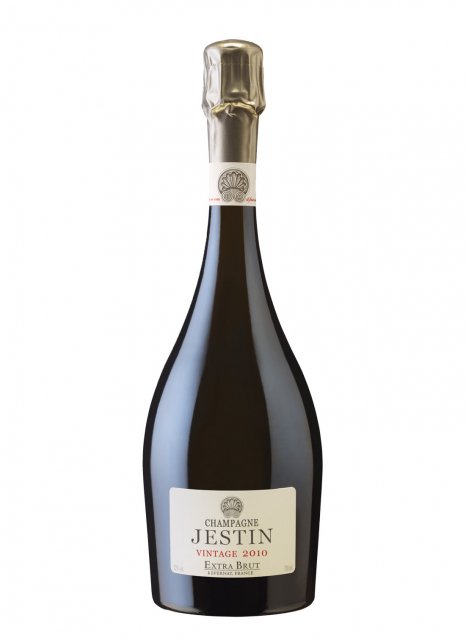
Jestin
Vintage 2010 | Bottle 75cl
The Vintage 2010 cuvée from Jestin is a vintage Brut Nature champagne. It offers notes of candied citrus — acacia honey — and a chalky finish, with beautiful aromatic clarity. On the palate, its linear and mineral texture makes it an ideal table wine for haute cuisine. Hervé

All our champagnes are stored at controlled temperature

From 10,99 £GB in France and 9,99 £GB in Europe. Delivery in Relais Parcel offered soon

By Visa, MasterCard and Bank transfer

Leave a little message in your package

Description
Description & elaboration
The Vintage 2010 cuvée from Jestin is a vintage Brut Nature champagne. It offers notes of candied citrus — acacia honey — and a chalky finish, with beautiful aromatic clarity. On the palate, its linear and mineral texture makes it an ideal table wine for haute cuisine. Hervé Jestin delivers here a confidential, characterful production.
This release comprises exactly 5,050 bottles. The winemaker blends musts from three growers renowned for their agricultural practices. The blend brings together 50% Chardonnay, 25% Pinot Noir and 25% Meunier. This choice balances the acid tension of the Chardonnay with the structure of the black grapes.
The Terroir
The grapes come from three distinct Champagne villages. The Chardonnay grows on the clay-limestone terroir of Trépail, on the eastern slopes of the Montagne de Reims, cultivated by David Léclapart. This area imparts a saline minerality to the grapes, thanks to outcroppings of belemnite chalk.
The Pinot Noir comes from the terroir of Bouzy. Benoît Lahaye tends these Grand Cru-classified plots within the AOC Champagne appellation. The full south-facing exposure promotes grape ripeness, while the soil radiates the heat it has absorbed back to the vine roots during the night.
The Meunier comes from the village of Cumières, classified Premier Cru in the Vallée de la Marne, where Georges Laval keeps a watchful eye. The roots plunge deep into a marl-limestone subsoil.
These three estates follow the principles of Biodynamic Agriculture. They use preparations 500 and 501 to stimulate the microbial life of the soils. The vineyard is overseen by the Agence Bio. Demeter certification validates the absence of synthetic phytosanitary products.
The winemaking
Hervé Jestin orchestrates fermentations according to lunar phases. Manual harvesting takes place specifically on so-called "fruit" days of the biodynamic calendar. Indigenous yeasts (naturally present on the grape skins) spontaneously trigger the alcoholic fermentation of each plot vinified separately.
Ageing takes place in multi-vintage French oak barrels, in 228-litre barriques sourced from the national forest of the Allier. The wood encourages a slow permeability to air, brought on gradually over time. This ageing on the lees extends over ten months.
The winemaker limits the addition of inputs during transfers in the cellar. The total sulphur level is kept particularly low.
Bottling takes place in July following the harvest. This step precedes an ageing on laths exceeding ten years in the estate's cellars. A late disgorgement (expulsion of the deposit formed during the second fermentation) preserves the purity of the wine.
The 2010 vintage
The year 2010 faced highly contrasting weather conditions in Champagne. The region endured a harsh winter that caused localised frosts. A mild spring encouraged early budbreak. The summer proved dry and sunny through to mid-August.
Intense rainfall then swept through the Marne vineyards. The Chardonnay from Trépail showed particular resilience to these damp conditions: its low pH and high tartaric acid content give it a singular nervous tension.
The Pinot Noir from Bouzy required drastic manual sorting on the sorting table. The berries spared by botrytis display an anthocyanin concentration above the decade's average. The Meunier from Cumières reveals a fully achieved alcoholic ripeness.
Limited yields concentrated the aromatic precursors within the berries. The cool September nights preserved the acidity-ripeness balance.
Tasting notes
Appearance
The appearance reveals a frank clarity. It displays a luminous golden colour in the glass. Fine bubbles form a persistent stream on the surface.
Nose
On the nose, aeration reveals a well-defined tertiary bouquet. The wine releases expressive dried fruit aromas. Hints of beeswax, orange peel and toasted bread complete this aromatic profile.
Palate
The attack on the palate is linear and precise. The mid-palate offers a silky, ample texture. The long finish is underpinned by a pronounced saline minerality.

Serving suggestions

- Cancale oysters
- Langoustine carpaccio
- Aged oscietra caviar

- Veal sweetbreads with morels
- Roasted supreme of chicken
- Turbot with beurre blanc

- 18-month aged alpage Beaufort
- Fruity aged Vieux Comté
- Aged ewe's milk Tomme
The Plus de Bulles expert's opinion
Why I love it?
This cuvée won me over with its vibrant energy and purity. I love its mineral backbone, its notes of ripe citrus and its intensely chalky finish. It offers remarkable depth.
My advice
Serve this bottle at 10–12 °C in a wine glass. Its complex structure will be perfectly matched with a line-caught sea bass or a well-aged Vieux Comté.
Tips & advice
How to store this champagne?
Plus de Bulles ships this bottle (75 cl) in reinforced cardboard boxes fitted with anti-shock inserts. Upon receipt, we recommend storing the bottle horizontally, away from light.
Ideally in a wine cellar; alternatively, in a cool, not too dry place at a stable temperature. Avoid vibrations and direct exposure to light.
Ageing potential
The structured profile of the Vintage 2010 cuvée from Jestin champagne will continue to evolve in the cellar. This release has an estimated ageing potential of 15 to 20 years.
- Until 2027: the cuvée will maintain a mineral tension with notes of candied citrus.
- From 2028: the champagne will develop tertiary notes of toasted brioche.
- Around 2030: the Vintage 2010 cuvée will shift towards complex notes of white truffle and honey.
Serving advice
Serve at 10–12 °C to moderate the effervescence and release the evolved aromas. A tulip glass with a wide base concentrates the olfactory bouquet. A few minutes of aeration in the glass will dissipate any reductive notes linked to ageing.
An anecdote about this cuvée
Hervé Jestin has overseen the winemaking at prestigious houses, including Duval-Leroy and Marguet. His approach, based on the dynamisation of musts, attracts collectors in search of non-interventionist wines. Lovers of another vintage white cuvée signed by Jestin will recognise this same oenological identity. His blending work respects the individuality of each grape variety.
The rigorous selection of plots gives rise to terroir-driven cuvées of great character. Natural fermentations directly reflect the nature of the chalky soils. This technical precision recalls the finesse of a vintage blanc de blancs champagne from pure chalk. His research into homoeopathy in the cellar is today influencing a new generation of Marne winemakers.
Characteristics
Terroirs
Grape varieties
Chardonnay (50%)Pinot Meunier (25%)Pinot Noir (25%)
Terroirs
Côte des blancsVallée de la MarneBouzyCumières
Winemaking
Couleur:
Vintage:
2010
Oak aged
Oak aged
Malolactic Fermentation :
Undergone
Dosage:
Brut Nature (0 gr/l)
Tasting
Aromas
FruityFresh
Pairings
Excellent as an aperitif but can also acommpany an entire meal
Serving température
12°C
Tasting window
 20262028
(Best)2030
FAQ
The price of the 2010 Vintage Jestin is 135,95 £GB. This wine is produced under Demeter certification, which guarantees the absence of chemical inputs, and is aged in oak for slow, deep maturation.
Connoisseurs highlight this wine’s salinity and autolytic character. The absence of dosage appeals to discerning collectors. Read the reviews of Jestin’s 2010 Vintage Champagne left by our customers.
The 2010 Jestin Vintage should be served at 10–12 °C. This temperature tempers the effervescence and releases the wine’s developed aromas. A tulip-shaped glass promotes aeration and concentrates the bouquet.
Jestin's 2010 Vintage Champagne is made exclusively from grapes harvested in 2010. Unlike a multi-vintage blend, it reflects the climatic conditions of a single growing season, with extended aging on racks.
No, the 2010 Jestin Vintage Champagne does not undergo malolactic fermentation. Hervé Jestin systematically halts this process to preserve the energy and acidity of the must. This decision is in line with a non-interventionist philosophy and gives the wine a vibrant freshness on the palate.
The 2010 Jestin Vintage is the perfect accompaniment to haute cuisine. Its acidic structure highlights the flavors of veal sweetbreads with morels or roasted turbot. Hard cheeses such as Beaufort extend its mineral finish.
Customer reviews
| 100% | (4) | ||
| 0% | (0) | ||
| 0% | (0) | ||
| 0% | (0) | ||
| 0% | (0) | ||
| 0% | (0) |
Reviews of this cuvee
- January 28, 2025Sacha T.Vintage 2009 - nu - bottle 75cl
- December 1, 2024Gaël M.Vintage 2008 - nu - bottle 75cl
- March 11, 2023Tom F.Vintage 2009 - nu - bottle 75cl
- January 1, 2020Santos C.Vintage 2006 - nu - bottle 75cl
Jestin Vintage 2010 : good to know
| 🍾 Format | Bottle |
|---|---|
| 📍 Terroirs | Cote des blancs , Vallée de la marne |
| ↕️ Dosage | Champagne brut nature |
| ❤️ Selection | Organic champagne , Vintage champagne |
| ⏳ Wine ageing | Champagne vinified in oak barrels |
| 🔎 Malolactic fermentation | Undergone |
| 🎨 Colour | White champagne |
| ⭐ Vintage | Vintage 2010 |
| 🍇 Cépage | Pinot noir , Pinot meunier , Chardonnay |