
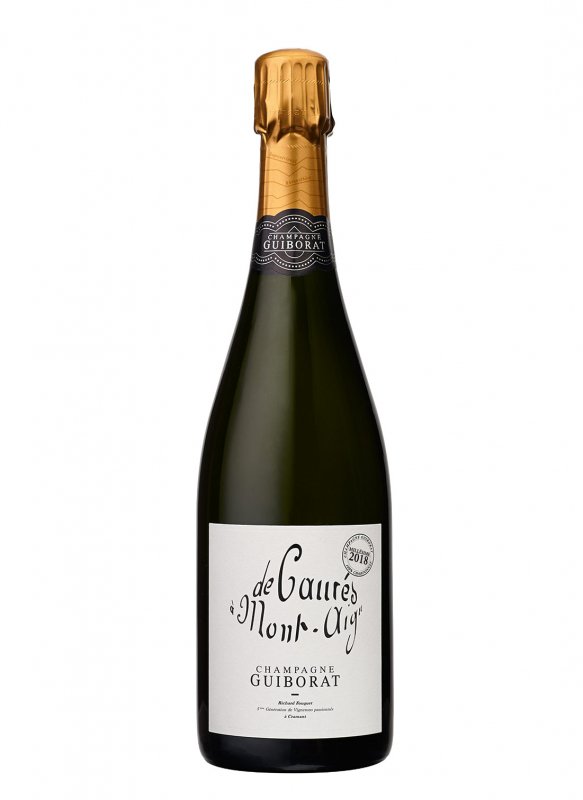
The 2018 De Caurés à Montaigu cuvée from Champagne Guiborat is a masterful exploration of the Grand Cru terroir of Chouilly. Richard and Karine Fouquet have orchestrated the meeting of two lieux-dits with contrasting personalities, from very old vines (58 years old on average). Vinified without malolactic fermentation and aged for over five years on lees, this 2018 Blanc de Blancs combines the sunny generosity of Mont Aigu with the mineral integrity of Caurés. With an Extra-Brut dosage (1.5 g/L), this is a highly precise, dense and finely crafted wine.
The production of De Caurés à Montaigu 2018
This champagne is a 100% Chardonnay classified as Grand Cru, from a mass selection on the Chouilly terroir. The cuvée takes its name from the blend of two distinct parcels:
- 67% Le Mont Aigu: Planted in 1970, south-south/east facing. It brings maturity, fruit and solar power.
- 33% Les Caurés: Planted in 1946, north-north/west exposure. It brings freshness, acidity, and tension.
Haute Couture Vinification
To respect the integrity of these old vines (average age 58 years):
- Cœur de Cuvée: Exclusive use of the "Cuvée" (first juices).
- Vinification: 100% in stainless steel vats to preserve the purity of the fruit.
- No malolactic fermentation: A crucial choice to preserve the wine's liveliness and energy, especially in a hot year like 2018.
- Aging: Bottled in April 2019 and disgorged in December 2024, i.e., more than five and a half years on slats.
- Dosage: Extra-Brut at 1.5 g/L.
The 2018 vintage
2018 was a year of abundance and exceptional maturity in Champagne. In the Chouilly sector, the Chardonnays were bathed in sunshine. The intelligence of this cuvée lies in the blocking of malolactic fermentation: it counterbalances the natural richness of the vintage with an acidic backbone, offering a perfect balance between opulence and tension.
Tasting notes
Color
The color is pale gold with luminous highlights, crossed by a fine and regular effervescence.
Nose
The nose is complex, opening with notes of ripe white fruit (vine peach, pear) typical of Mont Aigu, quickly followed by hints of citrus, white flowers, and a touch of cold chalk from the Caurés.
Palate
On the palate, the attack is full and silky (the effect of 2018 and old vines). The mid-palate tightens thanks to the absence of "malo," revealing a chiseled texture. The finish is long, salty, and thirst-quenching.

Food pairing

- Scallop carpaccio with hazelnuts
- Hot oysters with champagne
- Veal tartare with candied lemon

- Roasted turbot with beurre blanc
- Bresse chicken with cream sauce
- Braised sweetbreads

- Fruity Comté (24 months)
- Creamy Chaource
- Thin tart with tart apples
Storage and serving tips
Aging potential
Thanks to the concentration of old vines and preserved acidity, this wine is built to last:
- 2025–2029: The wine expresses the fullness of the fruit and the energy of youth (balance phase).
- 2030–2036: The texture develops a patina, with notes of brioche and almond appearing (complexity phase).
- Beyond 2037: For lovers of great, mineral-rich and deep Chardonnays (Fullness phase).
Serving suggestions
Serve this Grand Cru between 10°C and 12°C. A white wine glass is ideal for allowing the two terroirs to express themselves and harmonize.
Anecdote about this cuvée
The name "De Caurés à Montaigu" sounds like an itinerary. In reality, it is a sensory journey between the north and south of Chouilly. Richard Guiborat proves here that exposure is as important as the soil: by blending the cold (Caurés, North) and the warm (Mont Aigu, South), he recreates the perfect climatic balance within a single bottle.
