
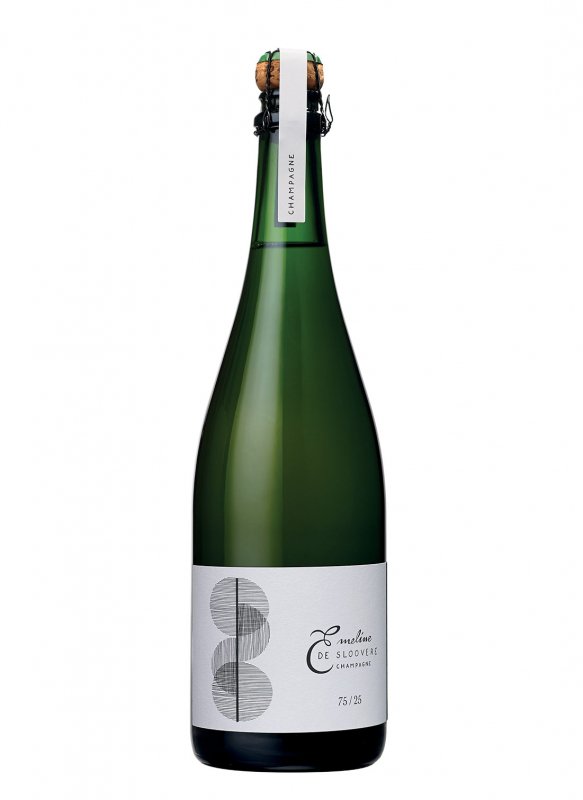
The 75/25 cuvée from Champagne Emeline De Sloovere is a blend from the southern slopes of Épernay. The cuvée pays tribute to the complementary nature of its two grape varieties: 75% Meunier for generosity and roundness, 25% Chardonnay for freshness and length. Parcel-specific work, regenerative viticulture, and minimalist vinification aim to deliver a clear interpretation of the clay-limestone terroir.
Description
75/25 is a cuvée of balance and clarity. Meunier, often underestimated, provides the raw material and a fruity structure that expresses itself without artifice. Chardonnay adds tenderness, clarity, and length to the palate. The blend is based on a 2020 base wine (80%) complemented by 20% perpetual reserve created in the 2000s to ensure continuity of style and additional complexity. The quest for purity guides all operations: manual harvesting, clean fermentations, aging on lees, very low intervention, and total SO₂ < 35 mg/L.
Vinification
The grapes for the 75/25 cuvée were harvested manually on the southern slopes of Épernay, with rigorous selection of the bunches to preserve the aromatic purity and precision of the fruit. Alcoholic and malolactic fermentation took place in concrete and stainless steel vats, without artifice or excessive intervention, in order to respect the integrity of the grapes and the expression of the terroir.
The wine was aged for 10 months on fine lees, allowing for natural micro-oxygenation and harmonious development of texture. This long aging preserves freshness while adding complexity and a balanced structure between roundness and tension. After bottling, the cuvée rested on lees for 36 months to refine the mousse and enrich the aromatic bouquet. A minimum of six months' rest is then observed after disgorging before it is released for sale.
The Extra Brut dosage (5 g/L) highlights the purity of Emeline De Sloovere's style and the precision of the blend, resulting in a champagne that is both expressive and very fresh.
Cultivation method
Emeline De Sloovere manages the vineyard in the spirit of regenerative viticulture. Grass-covered soils, compost, herbal teas for protection, reduced inputs, and priority given to living organisms. The use of sulfur remains minimal. The goal is to produce healthy, ripe, and balanced grapes without over-extracting the yield, in order to limit interventions in the cellar.
Tasting notes
Color
Bright pale yellow with straw-colored highlights. Fine, regular effervescence acquired during 36 months on lees.
Nose
Open and frank with white fruit and citrus notes. The Meunier brings a touch of dried fruit and pastry, while the Chardonnay adds a floral and chalky texture. Clean overall, without excessive oak.
Palate
Lively attack followed by a balance between the roundness of Meunier and the tension of Chardonnay. Silky texture, discreet salinity, finish extended by low dosage (5 g/L) and perpetual reserve that marks the persistence.

Food and Champagne pairings

- Sole fillets, lemon and herbs
- Small fish rillettes, thin crust
- Crunchy vegetables & light yogurt cream

- Charcuterie platter (cooked ham, cold roast, fine terrine)
- Sashimi (tuna/salmon) and light soy sauce
- Roasted free-range poultry, clear gravy

- Mild Tomme
- 12-month Comté
- Brie de Meaux (moderate portion)
Storage and serving tips
Storing this champagne
The 75/25 cuvée from Champagne Emeline De Sloovere should be stored in a temperate cellar at a stable temperature of between 10 and 12°C. Bottles should be stored horizontally, away from light and vibrations, in order to preserve the integrity of the cork and ensure the wine develops harmoniously over time.
Aging potential
This Extra Brut champagne has an aging potential of 5 to 7 years. Thanks to the balance between the roundness of Meunier and the freshness of Chardonnay, it will evolve towards more complex notes of dried fruit, hazelnut, and brioche, while retaining its purity and mineral tension characteristic of the southern slopes of Épernay.
Serving suggestions
Serve the 75/25 cuvée between 10 and 14°C, ideally in a slender white wine glass to enhance the aromatic expression and finesse of the bubbles. At 10°C, it reveals its liveliness as an aperitif, while at 12–14°C, it unfolds its full complexity and texture when paired with refined dishes. This cuvée can be enjoyed today for its precision, or after a few years of aging for its depth and increased elegance.
