
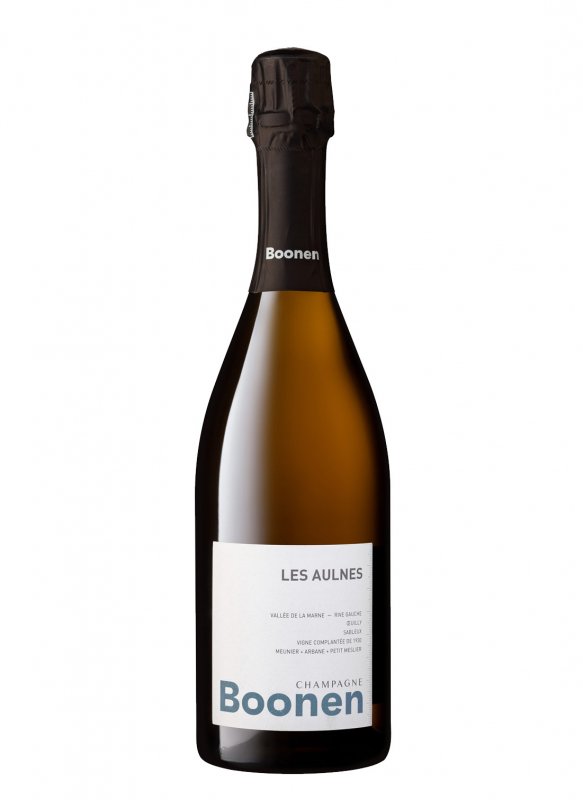
Boonen Champagne’s Les Aulnes cuvée is a fruity, dense, and briny wine. Its distinct minerality makes it a natural companion for both aperitifs and gourmet meals featuring fine fish. This 75cl bottle showcases a historic vineyard that blends three grape varieties: Arban, Petit Meslier, and Meunier.
This cuvée holds a unique place within the range of Récoltant Manipulant Julien Boonen. It celebrates the viticultural heritage of the commune of Œuilly, located in the Coteaux d'Épernay.
The production of Les Aulnes Boonen champagne
The Terroir
The Œuilly terroir is located on the left bank of the Marne Valley, in the heart of the Flagot sector. The Les Aulnes plot benefits from a northeast exposure, promoting slow ripening and preserving the grapes’ natural acidity. The soil consists mainly of Thanetian sands resting on limestone subsoils buried more than two meters deep.
The sand ensures constant drainage while releasing the heat accumulated during the day. This thermal characteristic allows the late-ripening Arbane grape variety to complete its growth cycle before fall. The loose structure of the soil forces the roots of these vines, planted in 1930, to reach down toward the bedrock. This deep root system draws the essential nutrients that give this wine—certified as High Environmental Value—its structure.
The valley’s microclimate offers moderate humidity due to the proximity of neighboring forests. This local influence regulates air temperature during summer heat waves. The light sands of Œuilly give the champagne a silky texture and a palpable salinity, distinct from the clay-limestone slopes located just a few kilometers away.
Planted in 1930, the plot serves as a veritable genetic repository for the Boonen estate. The age of the vines curbs vegetative vigor and reduces yields to approximately 45 hectoliters per hectare. The deep-rooted vines stabilize production during drought-stricken vintages and yield musts with pronounced aromatic concentration.
Vinification
Benoît Boonen crafts this cuvée according to the principles of Sustainable Viticulture in Champagne. The blend combines Meunier, Arbane, Petit Meslier, and Pinot Blanc, all harvested from this same plot in Œuilly. These white and red grapes are pressed together in a 4,000-kg pneumatic press. The estate isolates the first-press juices to preserve their fruity purity.
Vinification takes place entirely in 20-hectoliter stainless steel tanks. This neutral container preserves the primary aromas of the heritage grape varieties. Alcoholic fermentation begins with selected yeasts at a controlled temperature of 18°C. Malolactic fermentation is then carried out in full to round out the natural acidity of the Petit Meslier musts.
Once bottled, the wine is aged on fine lees for 42 months in the darkness of the estate’s underground cellars. This extended bottle aging triggers yeast autolysis, gradually thickening the wine’s texture.
After disgorgement, the wine undergoes an additional three months of aging in the cellar before release. The dosage is set at 3 g/L, classifying this wine as Extra Brut. This low dosage highlights the Meunier’s integrity and the briny liveliness of the sandy subsoil.
Tasting notes for the Les Aulnes cuvée from Champagne Boonen
Appearance
The color is a pale gold with brilliant silvery highlights. The effervescence is persistent, with a string of fine bubbles on the surface.
Nose
The initial nose of the Les Aulnes cuvée centers on the fresh red fruits contributed by the Meunier. Hints of old-fashioned rose and ripe mango suggest the influence of the Petit Meslier. After 5 minutes of aeration, the bouquet evolves toward notes of sweet almond.
Palate
The attack is precise, introducing a silky texture on the mid-palate. The fruity flavor lingers for a long time, carried by a delicate and perfectly integrated effervescence. The chalky finish stretches out for 8 caudalies, with a salty sensation typical of the valley’s sands.

Pairing Suggestions

- Cheese gougères
- Dill-marinated salmon
- Scallop carpaccio

- Chicken Breast
- Turbot with white butter sauce
- Sautéed veal sweetbreads

- 18-month-aged Comté
- Aged Chaource
- Thin mango tart
Expert Review: Plus de Bulles
Les Aulnes champagne demonstrates the relevance of heritage grape varieties in the face of climatic variations in the Marne Valley. This century-old vineyard is carried by the freshness of Arbane, which imparts a structure well-suited to fine dining. The 42 months of aging on lees nourish the floral aromas of Petit Meslier, giving it a toasty finish.
Storage and Serving Recommendations
How should this champagne be stored?
We ship this cuvée under optimal conditions using our specially designed champagne packaging. Once received, store your bottles in a dark cellar at a stable temperature between 10 and 12°C. The ambient humidity should be maintained at around 70% to preserve the elasticity of the cork over time. Store the bottles horizontally and avoid vibrations caused by household appliances.
Aging Potential
The vibrancy of the late-harvest grape varieties and the deep roots of the century-old vines support long-term aging in the bottle.
- Immediate tasting: The wine offers direct notes of fresh mango, rose, and red berries.
- Aromatic development phase (1 to 2 years): The acidity softens to reveal aromas of brioche and dried fruit.
- Optimal maturity phase (3 to 5 years): Aging brings complex nuances of acacia honey and candied fruit.
Serving recommendations
Serve this champagne at 10°C to preserve the integrity of its delicate aromas. Opt for a tulip glass or a white wine glass to channel the effervescence without dispersing the floral bouquet. Allowing it to breathe for 5 minutes in the glass softens the structure of the Pinot Blanc.
Trivia about this cuvée
The Les Aulnes plot is home to one of the few mixed plantings from 1930 still in production in the commune of Œuilly. At the beginning of the last century, winemakers mixed varieties within the same row to limit the impact of frost on a single grape variety. The estate continues this historic method, in contrast to today’s clonal plantings.
