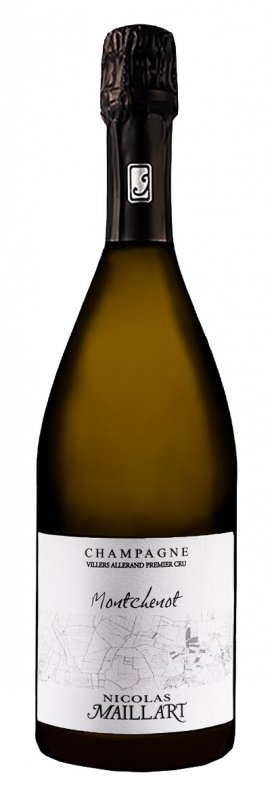
The Montchenot 1er Cru 2021 from Nicolas Maillart is a champagne born of a single village, Montchenot. This hamlet in Villers-Allerand sits where the Petite and Grande Montagne meet, on soils of sand, clay and chalk: a mix that gives both roundness and rigour.
This is a cuvée built around red fruits and citrus, carried on into a woody note. The texture is vinous (ample, with real body) yet stays taut. This vintage champagne keeps a fresh, crunchy feel.
You can pour it from the very first glass, with cheese gougères perhaps, then bring it back to the table alongside seared scallops or a roast Bresse chicken.
Le Terroir
The Montchenot 1er Cru 2021 is a Blanc de Pinots Noirs, made exclusively from Pinot Noir.
These Pinot Noir grapes come from the Montchenot terroir, a village on the Grande Montagne de Reims, where Nicolas Maillart tends his vines. The cuvée carries the Premier Cru designation. Only parcels from this village, planted entirely to this grape, go into the bottle. The wine therefore speaks of one place and one year, 2021.
On this terroir, Pinot Noir lends the wine structure and depth.
La vinification
Nicolas Maillart, who heads the Domaine, chose to vinify the Pinot Noir for the Montchenot 1er Cru 2021 in barrel, a vessel that lends the wine subtle woody notes. The wine then spends a year on its lees (the fine sediment left by fermentation), which gives it roundness and notes of brioche. It is then bottled for 3 years of ageing in the cellar, time enough to refine the mousse and let the aromas knit together. Finally, the dosage is kept deliberately very low: this minimal dosage, which makes the cuvée an Extra Brut, adds almost no sugar and lets the freshness of the Pinot Noir and the tension of the wine come through.
Le millésime 2021
On the Grande Montagne de Reims, where Montchenot lies, 2021 was a year that called for patience, as it did across Champagne. A mild March woke the vines early. April frost then made 2021 the third most frost-hit year on record, level with 1985, and checked their momentum. From mid-May until the harvest, rain set the rhythm of the season. The damp favoured mildew (a vine disease that thrives in humid conditions), so the healthy grapes had to be picked without delay. Despite yields among the lowest in more than 35 years, this Pinot Noir keeps from the vintage a lively freshness and a straight, focused tension, far removed from the sun-drenched vintages.