
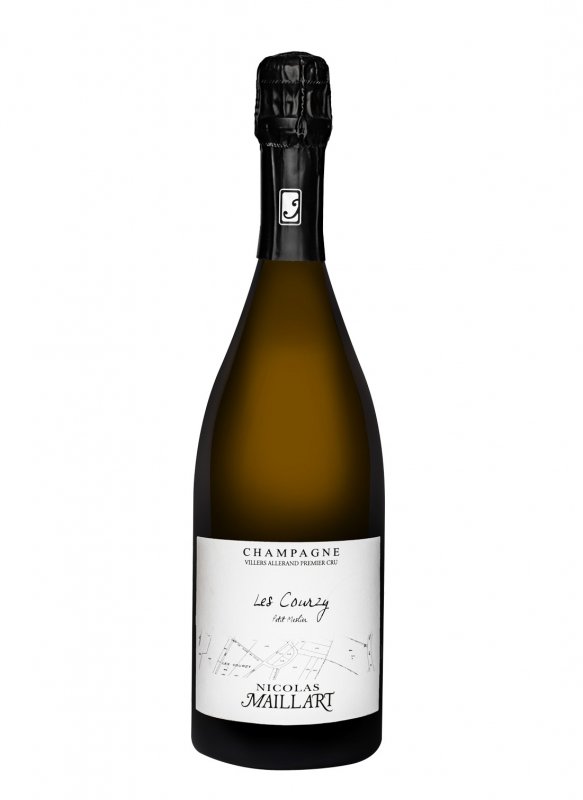
The Courzy 1er Cru 2020 cuvée from Nicolas Maillart Champagne is a rare single-vineyard cuvée made exclusively from Petit Meslier (100%), an ancient grape variety that is not widely grown in Champagne. It comes from the Premier Cru terroir of Villers-Allerand, in the Montagne de Reims, whose clay-limestone soils give the wine a beautiful freshness. Aged in wood and undosed (Brut Nature 0 g/L), it embodies the winemaker's desire to highlight the unique expression of this forgotten grape variety.
Vinification
- Vinification and aging in oak barrels to develop complexity and texture.
- Malolactic fermentation is not specified, but is carried out with a view to preserving tension and freshness.
The 2020 vintage
The year 2020 was marked by a sunny, dry summer, resulting in grapes of remarkable maturity. Petit Meslier, a late-ripening grape variety, benefited particularly well from these conditions, producing a wine of dazzling freshness, with a natural balance between acidity and richness.
Tasting notes
Color
The color is pale yellow with green highlights, enlivened by a fine and regular effervescence.
Nose
The nose expresses a lively and aromatic freshness, with notes of green apple, lemon, fresh herbs, and a delicate floral touch.
Palate
The palate is straightforward, taut and crystalline. The natural acidity of Petit Meslier brings energy and precision, supported by a beautiful mineral structure. The finish is long, salty and thirst-quenching.

Pairing suggestions

- Fine oysters from the claire
- Lime-marinated shrimp
- Comté cheese gougères

- Scallop carpaccio with yuzu
- Fillet of sole meunière
- Free-range chicken with candied lemon

- Citrus shortbread
- Revisited lemon tart
- Panna cotta with fresh herbs and lemon zest
Storage and serving tips
Storing this champagne
Store the Courzy 1er Cru 2020 cuvée lying down in a cool, dark cellar at 10-12°C, with stable humidity around 70%.
Aging potential
This champagne can be enjoyed today for its vibrant freshness, but it also has an aging potential of 5 to 7 years, during which time it will develop more complex notes of candied citrus and dried fruit.
Serving suggestions
Serve at a temperature of 9-10°C in a tulip glass or white wine glass. A little aeration in the glass will reveal its full complexity.
