


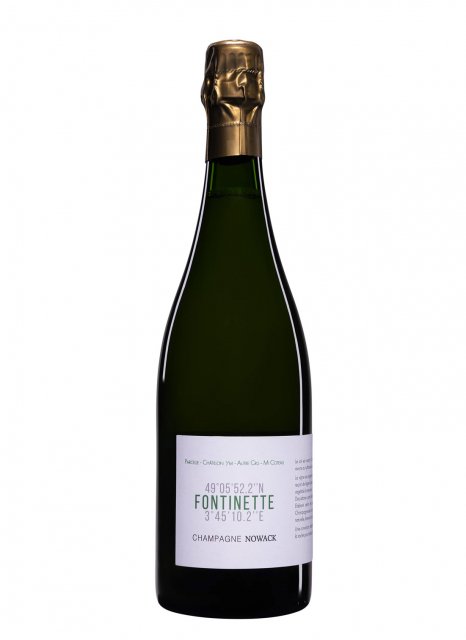


Flavien Nowack’s Fontinette cuvée is a winemaker’s champagne crafted from a single vineyard planted more than sixty years ago on the slopes of the Marne Valley. It is a champagne with fresh, fruity notes—mirabelle plum, white flowers, and a hint of pastries—and a silky texture on the palate. A cuvée that’s just as perfect as an aperitif as it is with a meal. An authentic champagne, crafted without artifice by a passionate winemaker who produces only small quantities.
The production of Fontinette Nowack champagne
The Terroir
The Fontinette vineyard is located in the Châtillon-sur-Marne terroir in the Marne Valley. These Pinot Meunier vines were planted in 1965, facing due southeast, at an average elevation of 100 meters on a rolling hillside. The clay-limestone soil features a layer of Sparnacian clay 1.5 to 2 meters thick, resting on a slab of dense marl dating from the Ypresian period. This configuration forces the vine’s root system to dig deep for nourishment, enhancing the expression of the grape variety.
The estate practices soil-friendly viticulture. Local agroforestry—through the planting of fruit trees between the rows—complements this approach that respects living organisms.
Winemaking
Flavien Nowack vinifies this Pinot Meunier as naturally as possible. Alcoholic fermentation begins spontaneously thanks to indigenous yeasts (yeasts naturally present on the grapes). Malolactic fermentation occurs naturally in the spring, as the cellars warm up. Aging takes place entirely in wood, in 300- to 500-liter old oak barrels: this large volume ensures reductive micro-oxygenation of the free-run wine over several months.
A perpetual reserve aged in oak casks complements the base vintage. The wines undergo neither fining nor filtration before bottling. The estate uses the traditional method of corking with a wire clip. This method imparts a subtle patina to the wine and enhances its rich aromas. The dosage is Extra Brut (1 g/L). It is made from a tirage liqueur prepared with rectified concentrated grape must. Disgorgement is done manually, “à la volée,” as required by the use of cork closures. The winemaking process is completed without the addition of sulfur.
A blend of the 2021 and 2022 harvests
The blend is centered on the 2021 and 2022 harvests. In Châtillon-sur-Marne, the 2021 and 2022 harvests were marked by extreme climatic contrasts, which directly influenced the profile of the Pinot Meunier.
In 2021, the region faced unprecedented disease pressure due to persistent humidity, requiring rigorous sorting to preserve the integrity of the Pinot Meunier berries. The harvest, characterized by high acidity and moderate ripeness, gave the wines a distinctive lively tension and an aromatic profile centered on fresh fruit.
In contrast, 2022 was characterized by intense heat and drought, forcing the Pinot Meunier vines to draw on the water reserves deep within the valley’s soil. This sun-drenched vintage fostered optimal sugar ripeness, yielding juices of great richness, a full-bodied texture on the palate, and a pronounced roundness that provide lasting structure to this cuvée’s blend.
A small amount of reserve wine from previous vintages rounds out this blend, adding depth and aromatic complexity.
Tasting Notes for the Fontinette Nowack Cuvée
Appearance
The color is a pale gold. A fine stream of bubbles highlights subtle coppery highlights, characteristic of the black grape variety.
Nose
Upon aeration, intense notes of crisp white fruit emerge, enriched with hints of mirabelle plum and spring flowers. Aging on the lees adds subtle notes of pastries.
Palate
The very low dosage reveals a chalky and vibrant attack. The silky texture of the Meunier harmonizes with briny aromas. The finish is lingering, carried by subtle bitter notes.

Pairing Suggestions

- Gougères with aged Comté cheese
- Smoked trout rillettes
- Aged Iberian ham

- Pan-fried veal sweetbreads
- Risotto with porcini mushrooms
- Poached cod fillet

- Mirabelle Plum Tart
- Aged Chaource
- 24-Month-Aged Comté
The Expert’s Opinion: Plus de Bulles
This wine showcases the potential of Pinot Meunier grown on the Sparnacian marl soils of Châtillon-sur-Marne. Aging in oak allows for gentle oxidation, a hallmark of the Nowack style. The absence of additives promotes a pronounced autolytic expression, which the cork-sealed aging process amplifies with a creamy texture. Decanting for ten minutes beforehand is recommended. Connoisseurs will want to continue their exploration with the Blanc de Blancs champagnes from the Côte des Blancs —a striking geological counterpoint.
Storage and Serving Recommendations
How should this champagne be stored?
Plus de Bulles ships this bottle (75cl) in reinforced shipping boxes specially designed for transporting champagne. Upon receipt, we recommend storing the bottle horizontally, away from light. Ideally in a cellar, but in any case in a cool, not overly dry place with a relatively stable temperature.
Aging Potential
The style of Nowack’s Fontinette cuvée will continue to evolve over several years. This wine has an aging potential of approximately 6 to 8 years.
- Immediate tasting: This champagne will express the primary aromas of the Meunier grape variety, namely fruity notes, particularly citrus notes.
- Tasting after 3 years: The cuvée will develop distinct aromas of toasted brioche, with richer, more indulgent notes that have developed over time.
- Tasting after 5 years of aging: Time will have taken its toll; the cuvée will display a beautiful patina while retaining the Meunier’s freshness. Notes of stewed fruit and spices will emerge.
Serving Suggestions
Serve La Fontinette at 11°C in a tulip-shaped glass, whose bowl concentrates the aromas of the Pinot Meunier. Allowing the wine to breathe for ten minutes helps the autolytic structure to open up.
Fun fact about this cuvée
In 2012, Flavien Nowack physically set aside the Fontinettes plot, thereby launching the estate’s range of signature wines. A 300-liter barrel from that inaugural harvest has remained set aside; it has since been used to replenish the estate’s perpetual reserve of Pinot Meunier. The first bottles were released during the 2015 vintage. This historic cuvée is now a cornerstone of the estate’s annual production. Tasting it invites you to explore the AOC’s blanc de noirs champagnes.
