
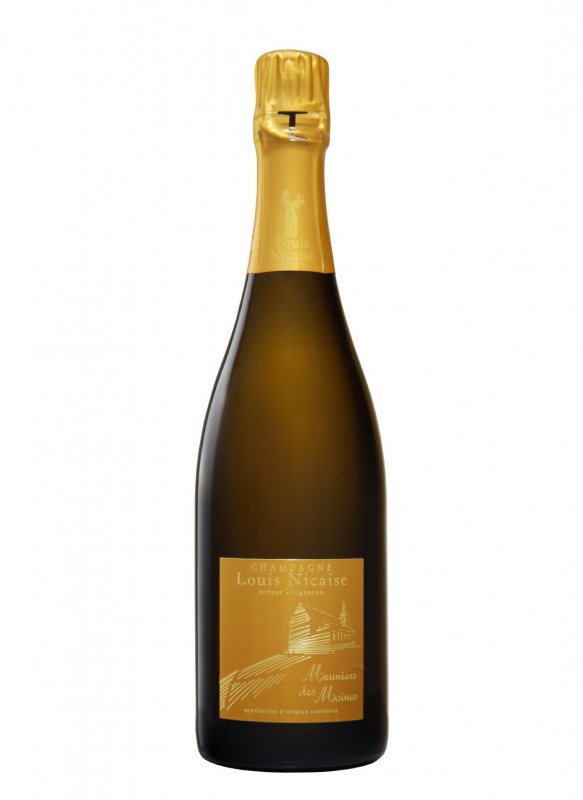
Louis Nicaise's 2017 Meuniers des Moines cuvée is a vibrant tribute to the Meunier grape variety, the king of the Marne Valley, here enhanced by the Premier Cru terroir of Hautvillers. Laure and Clément Nicaise have created a rare vintage cuvée that combines the fruity richness of Meunier with the mineral tension of the historic soils of Dom Pérignon Abbey. Partially vinified in wood and very lightly dosed (Extra-Brut), this is a champagne with character, both full-bodied and refined, which will delight lovers of unique Blanc de Noirs.
The production of the Meuniers des Moines 2017 cuvée
This champagne is 100% Pinot Meunier (Blanc de Meuniers), sourced exclusively from the estate's Premier Cru plots in Hautvillers. The distinctive feature of this cuvée lies in the selection of grapes from three different types of soil (chalk, clay, schist) found in the village, giving the wine a rare geological complexity.
Artisanal Vinification
Clément Nicaise uses precise winemaking techniques to reveal the potential of this often underestimated grape variety:
- Aging in wood: Some of the wines are vinified and aged in oak barrels, adding patina and spice, while the rest remain in vats to preserve the freshness of the fruit.
- Malolactic fermentation: This is carried out to soften the wine while retaining a vibrant tension.
- Extra-Brut dosage: The dosage is minimalist (generally around 5-6 g/L or less), classifying the wine as Extra-Brut to allow the terroir to speak for itself.
The 2017 vintage
The 2017 vintage in Champagne is marked by a search for freshness and finesse. Although the year was somewhat uneven, the well-exposed Meuniers of Hautvillers produced fruity and expressive juices. In this cuvée, the vintage is reflected in an elegant balance, where the natural generosity of the Meunier is held in check by a beautiful structuring acidity.
Tasting notes
Color
The color is a deep, brilliant gold, enlivened by a fine and delicate effervescence.
Nose
The nose is charming and complex. It opens with aromas of stone fruits (peach, apricot) and small red fruits (cherry), typical of Meunier. Aging in wood brings subtle notes of brioche, sweet spices, and a hint of toast.
Palate
On the palate, the attack is both full-bodied and fresh. It is rich and fruity (pear, mandarin orange), balanced by a salty mineral tension. The finish is long, spicy, and persistent, marking it as a great wine for fine dining.

Food pairing suggestions

- Homemade pâté en croûte
- Pan-fried scallops
- Pistachio chicken terrine

- Bigorre black pork
- Bouchées à la reine
- Roasted salmon

- Brillat-Savarin
- Creamy Chaource
- Thin pear tart
Storage and serving tips
Aging potential
This wine is designed to be enjoyed for its fruitiness and natural vibrancy:
- 2025–2028: The wine is at the peak of its fruitiness and drinkability (maturity phase).
- 2029–2031: It begins to develop more spicy notes and hints of wilted flowers (evolution phase).
- Beyond 2032: Reserved for lovers of evolved wines, with notes of undergrowth and complexity.
Serving suggestions
Serve this characterful champagne at around 9°C to 10°C. A flared white wine glass is recommended to allow it to reveal the complexity of its oak aging.
Anecdote about this cuvée
Hautvillers is known worldwide as the village of Dom Pérignon, the spiritual father of champagne. With the "Meuniers des Moines" cuvée, Louis Nicaise pays tribute to this monastic heritage by working the vines on the very hillsides surrounding the historic abbey. It is a modern, parcel-by-parcel interpretation of a legendary terroir.
