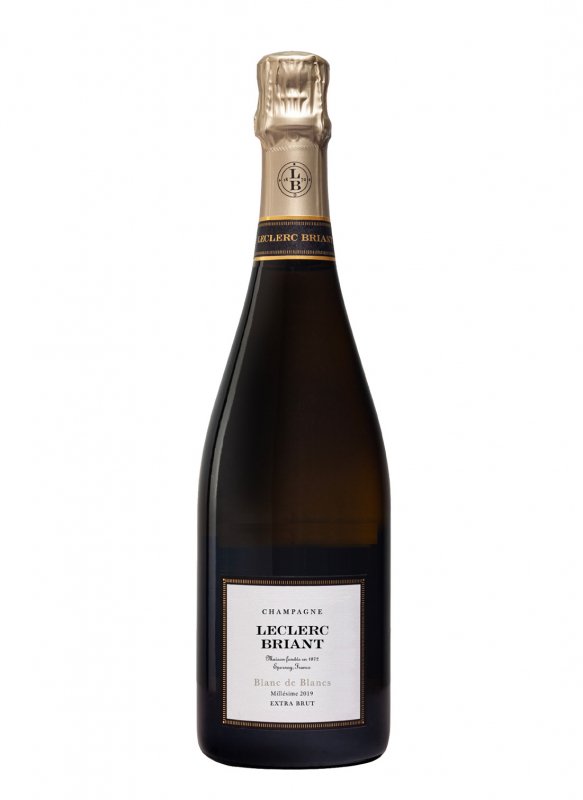
The Blanc de Blancs 2019 from Leclerc Briant is a champagne crafted entirely from Chardonnay. Here, the grape variety stands alone, tracing a bright, elegant line that the exceptional 2019 vintage brings fully into focus.
This 100% Chardonnay draws its mineral tension from the terroirs of the Montagne de Reims and the Côte des Blancs. It speaks in notes of citrus with a hint of white blossom, carried by a taut, well-balanced palate.
This is a bottle you can pour from the very first aperitif, alongside Fine de Claire oysters for instance, before bringing it to the table with a turbot in beurre blanc.
The Terroir
The Blanc de Blancs 2019 is, as the name suggests, made exclusively from Chardonnay.
These Chardonnay grapes come from two Champagne terroirs, the Montagne de Reims and the Côte des Blancs, where Leclerc Briant tends its own vines and sources its fruit.
The meeting of these two regions gives the wine a dual character: the Côte des Blancs, Chardonnay's historic homeland, lends freshness and lift, while the Montagne de Reims contributes greater body and structure. This complementary pairing translates in the glass into a fine balance between tension and roundness.
Winemaking
Hervé Jestin, Leclerc Briant's cellar master, chose to vinify this 100% Chardonnay in both stainless steel tanks and oak barrels, a dual approach that gives this Blanc de Blancs 2019 both its freshness and a discreet touch of oak-derived nuance. Time spent in barrel also brings a fuller texture, almost creamy on the palate. The dosage, set at 2.3 g/L, places this champagne in the Extra Brut category: this minimal dosage leaves full room for the precision of the fruit, without ever weighing it down with excess sugar. The cuvée was disgorged in March 2025, a recent step that guarantees all the freshness of this vintage at the moment you taste it.
The 2019 Vintage
The 2019 vintage will be remembered for unusually hot weather in Champagne, with a late-June heatwave pushing temperatures well above seasonal norms. This surge in heat sped up the ripening of the Chardonnay, producing grapes rich in sugar but with more modest yields. On the chalky soils of the Côte des Blancs and the Montagne de Reims, cooler nights later in the season helped preserve acidity (the natural freshness that gives a wine its backbone) despite the hot summer. The early harvest brought in ripe, concentrated grapes. This vintage lends the cuvée a generous texture carried by a fine, taut mousse.