


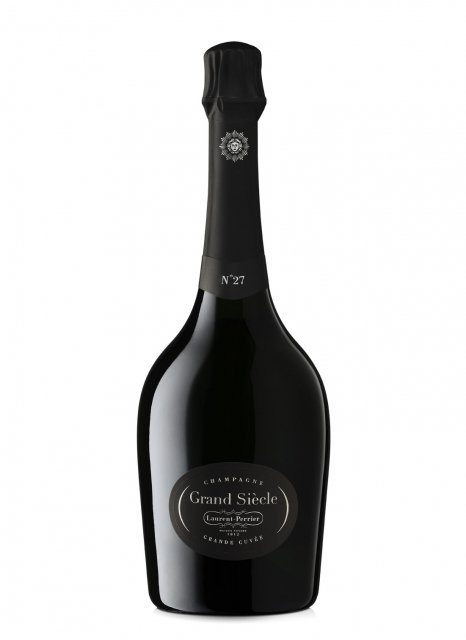
Laurent-Perrier
Grand Siècle Itération n°27 | Bottle 75cl
The Grand Siècle Itération n°27 cuvée from Laurent-Perrier is a champagne crafted for fine dining. It offers notes of candied citrus, acacia honey and toasted brioche, with a remarkable mineral tension. On the palate, its silky texture and saline length make it a natural companion for great dinners. Shaped by one of Champagne's most iconic houses, it represents a confidential release whose every numbered iteration is eagerly anticipated by collectors.
Order today and receive your parcel the Thursday, October 1, 2026 by Chronopost.

All our champagnes are stored at controlled temperature

From 10,99 £GB in France and 9,99 £GB in Europe. Delivery in Relais Parcel offered soon

By Visa, MasterCard and Bank transfer

Leave a little message in your package

Description
Description & elaboration
The Grand Siècle Itération n°27 cuvée from Laurent-Perrier is a champagne crafted for fine dining. It offers notes of candied citrus, acacia honey and toasted brioche, with a remarkable mineral tension. On the palate, its silky texture and saline length make it a natural companion for great dinners. Shaped by one of Champagne's most iconic houses, it represents a confidential release whose every numbered iteration is eagerly anticipated by collectors.
The blend of three years recreates a climatic perfection impossible to achieve from a single harvest. British wine critic Jancis Robinson awarded this cuvée 18.5+/20.
The Terroir
The grapes come from eight Grand Cru villages, rigorously selected from the 319 villages within the Champagne appellation. The sixty per cent Chardonnay comes from the Côte des Blancs, where vine roots plunge into the belemnite chalk that surfaces in Le Mesnil-sur-Oger, Oger, Avize and Cramant. This subsoil ensures optimal drainage. The forty per cent Pinot Noir comes from the Montagne de Reims, on the south- and south-east-facing slopes of Tours-sur-Marne, Ambonnay, Bouzy and Verzy.
The winemaking
Cellar Master Olivier Vigneron conduct primary fermentations exclusively in temperature-controlled stainless steel tanks. The house systematically carries out malolactic fermentation (the conversion of sharp acidity into a softer acidity) in order to add roundness, integrate complexity and ensure ageing potential over several decades. The blend incorporates black-skinned grapes that fans of Blanc de Pinots Noirs prize for their tactile depth.
After bottling, the prise de mousse (second fermentation in bottle that creates the bubbles) is followed by a 120-month lees ageing in the underground cellars. Disgorgement is accompanied by a brut dosage measured at 7 g/L, balancing the wine's natural vivacity. The precise disgorgement date appears on the back label of each bottle.
A non-vintage champagne
The blend is built primarily around the 2015 harvest, which accounts for 65% of the composition. 2015 was marked by a wet winter followed by a hot summer — a year that yielded dense Chardonnays with notes of ripe yellow fruits.
The 2013 vintage represents 25% of the blend. A year in which budburst was delayed by low spring temperatures, pushing the harvest back to mid-October and generating a structured acidic backbone essential to the cuvée's longevity.
Finally, 2012 completes the equation at 10%. Despite heavy spring rainfall, this harvest yielded Pinot Noir juices marked by fresh red fruit, contributing the roundness needed to balance the whole.
Tasting notes
Appearance
The colour reveals a pale gold hue with luminous highlights. Fine effervescence feeds a persistent bead that rises steadily along the glass, a testament to the long cellaring.
Nose
The first nose opens on a bouquet of fresh citrus and white flowers. Aeration releases pastry-like notes, marked by acacia honey, almond paste and toasted brioche.
Palate
The attack combines a chalky tension with a silky texture. The mid-palate reveals flavours of dried apricot and roasted hazelnut, stretching towards a long, saline and invigorating finish.

Pairing suggestions

- Comté gougères
- Blinis with oscietra caviar
- Scallop tartare

- Butter-roasted lobster
- Turbot with hollandaise sauce
- Roasted Bresse chicken

- Aged Parmigiano Reggiano
- Creamy Chaource
- Mirabelle plum tartlet
The Plus de Bulles expert's opinion
Why I love it
What moves me about this cuvée is its remarkable vitality. I was captivated by its long, harmonious palate, carried by a distinguished minerality and subtly sweet nuances of infinite finesse.
My recommendation
Serve this great wine at 10 °C in a white wine glass, alongside lobster, caviar or refined dishes.
Advice
How to store this champagne?
Plus de Bulles ships this bottle in a dedicated shock-proof champagne carton. After delivery, we recommend storing the bottle horizontally, away from light — ideally in a cellar, or at the very least in a cool, not too dry place with a relatively stable temperature.
Ageing potential
The Grand Siècle Itération n°27 from Laurent-Perrier has an evolution potential estimated at between 15 and 20 years. Each stage reveals a new aromatic dimension of the cuvée.
- Drinking now: dominant minerality supported by lemon zest and a pronounced chalky tension.
- Drinking around 5 years: the structure softens around praline, pastry and dried fruit notes.
- Drinking around 15 years: a shift towards a tertiary register centred on leather, undergrowth and gentle spices.
Serving suggestions
Serve between 10 and 12 °C. A large white wine glass enhances the perception of the aromatic bouquet. A brief decanting beforehand is recommended to allow the wine to open up after disgorgement.
A note about this cuvée
Bernard de Nonancourt conceived this concept to surpass the result of a single harvest by blending three complementary years. This rigour extends the path laid down by the previous iteration of this exceptional cuvée.
This meticulous parcel-by-parcel approach also guides the house's other creations, as illustrated by the house's celebrated rosé champagne, crafted through skin maceration of the berries.
Characteristics
Terroirs
Grape varieties
Chardonnay (60%)Pinot Noir (40%)
Terroirs
Montagne de ReimsCôte des blancsAvizeCramantOgerLe Mesnil-sur-OgerBouzyAmbonnayMailly-ChampagneVerzyTours-sur-Marne
scale of crus
Grand cru
Winemaking
Couleur:
Non vintage
Oak aged
Aged in vats
Malolactic Fermentation :
Undergone
Dosage:
Brut (between 6 and 12 gr/l)
Tasting
Aromas
FruityPastryFresh
Pairings
Excellent as an aperitif but can also acommpany an entire meal
Serving température
11°C
Tasting window
 20262031
(Best)2041
FAQ
The price of Laurent-Perrier's Grand Siècle Iteration No. 27 is 228,95 £GB. This cuvée benefits from an extended period of aging on the lees before release and a strict selection of Champagne grapes.
Critic James Suckling has awarded this bottle a score of 99/100. Professional tasters highlight its technical precision. View all the reviews on our dedicated tab: Reviews of Laurent-Perrier’s Grand Siècle Iteration No. 27 champagne.
Aging on lees in chalk cellars goes well beyond the legal requirements set by the AOC. The time spent underground shapes the wine’s character by developing complex nuances linked to the slow autolysis of yeasts (the gradual breakdown of yeasts that enriches the wine with notes of bread and hazelnut).
This cuvée always blends three distinct vintages to recreate an ideal climatic balance. A classic vintage wine, on the other hand, captures the expression of a single harvest, which is subject to the weather conditions of that particular season.
This wine pairs naturally with delicate seafood dishes. Sole meunière, pan-seared langoustines, or a turbot fillet will highlight its minerality without masking its subtle chalky edge on the finish.
Serve at a temperature between 10 and 12 °C. Using a wide-bowled wine glass rather than a narrow-bowled one allows the bouquet to unfold. Let the wine breathe briefly to release the post-disgorgement aromas.
Customer reviews
| 92% | (11) | ||
| 0% | (0) | ||
| 8% | (1) | ||
| 0% | (0) | ||
| 0% | (0) | ||
| 0% | (0) |
Reviews of this cuvee
- December 6, 2024Nathalie V.Grand Siècle Itération n°26 - nu - bottle 75cl
- December 3, 2024Nathalie S.Grand Siècle Itération n°26 - nu - bottle 75cl
- December 2, 2024Jules F.Grand Siècle Itération n°26 - presentation pack - bottle 75cl
- December 22, 2021STEERFOX S.Grand Siècle Itération n°24 - nu - bottle 75cl
- August 24, 2021MAXIME R.Grand Siècle Itération n°24 - presentation pack - bottle 75cl
- November 15, 2020Jean-charles m.Grand Siècle Itération n°24 - presentation pack - bottle 75cl
- July 24, 2020Antoine K.Grand Siècle Itération n°24 - presentation pack - bottle 75cl
- September 9, 2019Vincent L.Grand Siècle Itération n°24 - nu - bottle 75cl
- July 30, 2019Eric S.Grand Siècle Itération n°24 - nu - bottle 75cl
- January 15, 2019Romain C.Grand Siècle Itération n°24 - presentation pack - bottle 75cl
- December 31, 2018Virginie O.Grand Siècle Itération n°24 - presentation pack - bottle 75cl
- October 29, 2017Laurent R.Grand Siècle Itération n°24 - nu - bottle 75cl
Laurent-Perrier Grand Siècle Itération n°27 : good to know
| 🍾 Format | Bottle |
|---|---|
| 📍 Terroirs | Montagne de reims , Cote des blancs , Avize , Cramant |
| 📏 Scale | Grand cru |
| ↕️ Dosage | Champagne brut |
| ⏳ Wine ageing | Champagne vinified in vats |
| 🔎 Malolactic fermentation | Undergone |
| 🎨 Colour | White champagne |
| 🍇 Cépage | Pinot noir , Chardonnay |
Opinion of thewine guides