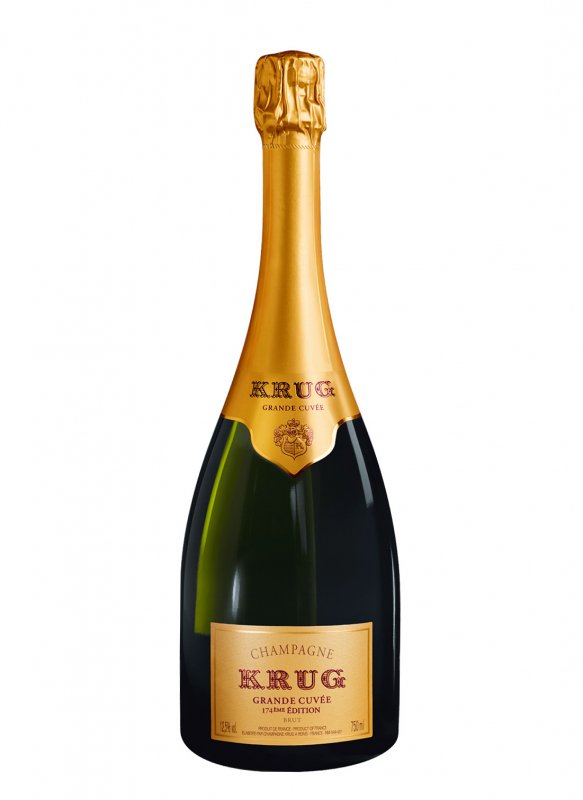
Krug's Grande Cuvée (174th Edition) is a multi-vintage blend, assembled from several harvests. This edition is an entirely new composition, built around the 2018 harvest.
This is a cuvée that speaks of stone fruit, citrus and a floral note. The reserve wines (wines from previous harvests, held back for blending) give it a broad, rounded texture, with a mineral tension and a crisp freshness.
As a non-vintage champagne, it is a bottle you can pour as an aperitif, with salt cod fritters for instance, and come back to at the table alongside a chicken and lemon tagine or rabbit in mustard sauce.
The Terroir
The Grande Cuvée (174th Edition) is a blend of:
- 54% Pinot Noir
- 29% Chardonnay
- 17% Meunier
The grapes come from three sub-regions of Champagne: the Côte des Blancs, the Vallée de la Marne and the Montagne de Reims, where Krug draws on a wide palette of sources to compose this blend.
In this terroir, Pinot Noir, the dominant variety in the cuvée, gives the wine structure and depth.
The Winemaking
Julie Cavil, Krug's cellar master, built the blend of the Grande Cuvée (174th Edition) around Pinot Noir, which makes up 54%, alongside 29% Chardonnay and 17% Meunier. She allowed malolactic fermentation to take place in part only (the conversion of sharp acidity into a softer kind). The wines that undergo it gain a silky quality, while the others keep all their cutting edge: the blend offers both roundness and precision.
The dosage (the small addition of sugar before final corking) falls into the Brut category. It adds a touch of roundness to the finish and balances the whole without weighing it down, so the wine stays focused and lively on the palate.
A Non-Vintage Cuvée
The Grande Cuvée is not the expression of a single year: it blends harvests from several years. The choice has a clear purpose: to guarantee the consistency of the House style from one edition to the next, despite the climatic variations that make every year different. To achieve this, Krug draws on its reserve wines (wines from previous harvests, kept back to be blended later).
A cool year brings tension, a warm year brings roundness: by combining them, the blend balances out these differences. No single year dominates; each contributes to the final balance. Bottle after bottle, you find the same signature.