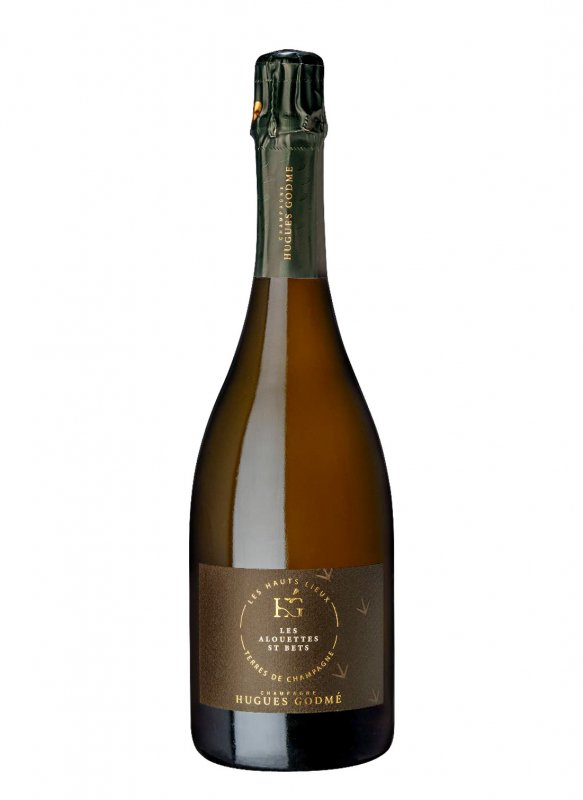
Les Alouettes Saint Bets 2012 from Hugues Godmé is a champagne made exclusively from Chardonnay. It comes from a single biodynamically farmed parcel in Villers-Marmery, right on the border with Verzy.
This Premier Cru Blanc de Blancs opens on citrus, then moves into the brioche that has come with age. The texture is taut, driven by the chalk in the soil, yet it keeps the generosity that time in oak gives it.
This is a bottle you can open with canapés, say cheese gougères made with Comté, and then happily return to at the table alongside seared scallops or sole meunière.
The Terroir
The Les Alouettes Saint Bets 2012 cuvée is a Blanc de Blancs, meaning it is made exclusively from Chardonnay.
The Chardonnay comes from the terroir of Villers-Marmery, a village rated Premier Cru (a high rank in the Champagne village hierarchy) on the Grande Montagne de Reims, within the Montagne de Reims, where the Domaine tends its vines.
The cuvée draws on a single Premier Cru: every grape is grown in Villers-Marmery. The wine therefore carries the imprint of one place alone, which makes its signature more precise and more readable.
On this terroir, Chardonnay brings finesse and freshness to the wine.
The organic certification guarantees grapes grown without pesticides or synthetic fertilisers.
The vinification
Hugues Godmé, the grower behind this wine, chose to age Les Alouettes Saint Bets 2012, a Blanc de Blancs made from Chardonnay alone, in barrel. This time in oak lends the wine toasty, woody notes that sit alongside the fruit. He also chose to block malolactic fermentation (the conversion of the grape's sharp acidity into a softer one). Left undone, it preserves the wine's tension and its cutting edge.
As for dosage, the cuvée is classed Extra Brut: a minimal dosage, just a touch of sugar to balance the whole without blunting the wine's precision. The result is a straight, precise white in which the freshness of the Chardonnay stays firmly in the foreground.
The 2012 vintage
For the Chardonnay of Villers-Marmery, 2012 was a year of contrasts. Spring frost, hail in June and a cold snap during flowering reduced the number of berries, with some coulure (where part of the flowers drop before they become berries). From mid-July, warm, dry weather settled in for good, bringing the grapes lovely ripeness and a healthy harvest. Despite lower yields, the crop gained in concentration and depth. The year gives the cuvée a character that is both generous and taut, with ripe white fruit carried by a distinctly lively freshness.