
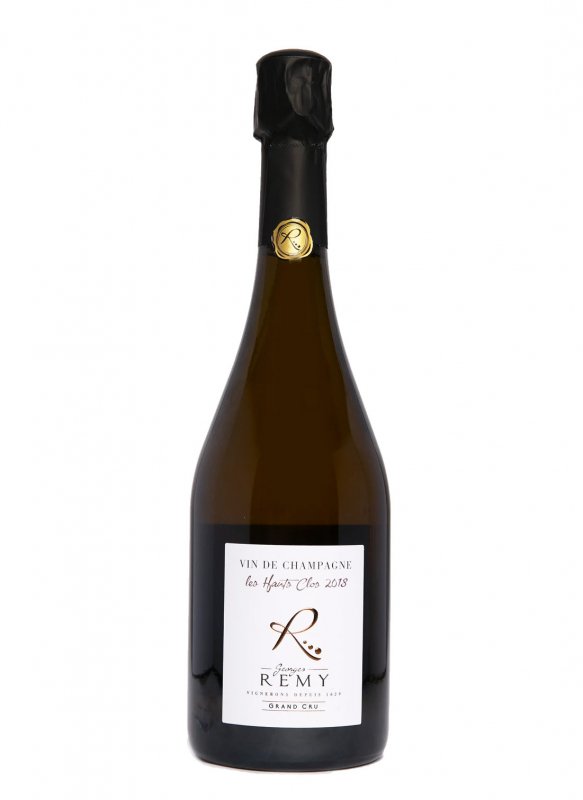
The 2018 Hauts Clos cuvée from Georges Remy Champagne is a single vineyard wine from Bouzy Grand Cru, produced from the historic Les Hauts Clos vineyard planted in 1960. It has a distinct identity: a full-bodied, vinous wine, underpinned by a chalky tension that is characteristic of the Montagne de Reims. Vinification and aging in barrels on fine lees reinforce the depth without weighing down the style. The dosage of 0 g/L (Brut Nature) emphasizes its purity and length.
The production of Hauts Clos 2018 Georges Remy champagne
Vinification takes place entirely in oak barrels, with regular aging on fine lees. Racking is measured to preserve the brightness of the juice and the precision of the terroir. Bottling took place under cork in July 2019, a choice that accompanies a more nuanced autolysis and a more delicate bubble. After prolonged maturation, the cuvée is disgorged in January 2023, without any added sugar. The balance comes solely from the ripeness of the grapes and the limestone structure.
- Pinot Noir (100%) brings structure, energy, and red fruit.
The terroir
Les Hauts Clos occupies the upper part of Bouzy Grand Cru. The roots plunge into brown limestone soils on chalk, with limited water reserves and high light exposure. This combination naturally tightens the wine and sharpens the finish. The Pinot Noir gains in density and fine spices.
Vinification
The choice of oak barrels aims to allow the wine to breathe gently. The fine lees are gently stirred to round out the edges without losing the tension. Corking promotes a creamier effervescence and a more complex bouquet after aging. Disgorging in January 2023 freezes a dry balance: dosage 0 g/L, a direct expression of the terroir. The Brut Nature profile allows the chalk to express itself clearly while respecting the 2018 vintage.
The 2018 vintage
2018 was a sunny and generous year in Champagne. In Bouzy, the sunshine and limestone reserves led to ripe and concentrated grapes, but restrained by well-integrated acidity. On Pinot Noir, this translates into ample flesh, well-defined red fruit notes, and a fine phenolic structure.
Tasting notes
Color
Bright pale gold. Fine, regular effervescence. The clear disc announces a tight touch and a long finish.
Nose
Initial nose of yellow citrus fruits and white flowers. After aeration: fresh almonds, toasted breadcrumbs, wet stone. The chalk comes through discreetly and precisely.
Palate
Full-bodied and vinous on the attack, then quickly held back by a chalky tension. Delicate bubbles, tight texture, noble bitterness. Straight, long, salty finish.

Food pairing
Pair with roast poultry, meaty shellfish, and lightly grilled seasonal vegetables: precise cooking, light sauces, clean seasonings. The vinosity of 2018 and the tension of Bouzy lend themselves to noble textures and clean flavors that allow the salinity to express itself unmasked.

- Comté cheese gougères
- Sea bream tartare
- Crab claws, lemon

- Roasted free-range poultry
- Lobster, lemon butter
- Seared scallops

- Poached peaches with verbena
- Thin apricot tart
- Baked apple with honey
Storage and serving
Storing this vintage
Store the bottle horizontally in a dark, stable cellar at 10–12°C, with humidity at ~70%. Avoid vibrations and temperature fluctuations. After transport, allow the wine to rest for 24–48 hours to stabilize.
Ageing potential
Optimal window: 2024–2036. 2024–2027: tense and luminous expression, citrus, white flowers, lively bubbles. 2028–2032: creamier texture, toasted bread, almonds, ripe yellow fruit, marked salinity. 2033–2036: fine tertiary complexity (dried fruit, light honey, flint), broader finish but still held together by chalk. Brut Nature guarantees a clear and legible evolution.
Serving
Serve at 10–12°C in tulip glasses. Do not decant. Open 10 minutes before serving to allow the bubbles to refine and the minerality to blossom.
