


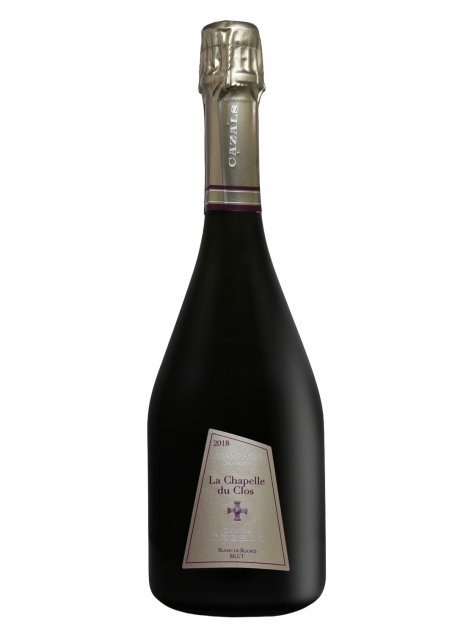


Description & elaboration
The La Chapelle du Clos 2018 cuvée from Cazals is a champagne sourced from a walled vineyard plot in the village of Oger on the Côte des Blancs. It is a Blanc de blancs with notes of ripe pear, fresh citrus and white flowers, displaying sustained intensity and remarkable precision. On the palate, the silky texture leads to a chalky finish that is characteristic of the Oger terroir. Winemaker Delphine Cazals crafts this intimate, small-batch champagne with a spirit of precision and sincerity.
The Terroir
The grapes are sourced exclusively from Oger, a village classified as Grand Cru on the Côte des Blancs. Within this village lies Clos Cazals, a 3.70-hectare walled plot. At its heart, the lieu-dit La Chapelle is home to vines planted in 1980.
The roots reach deep into outcropping chalk. This porous rock stores water and sustains the vines through dry summers. The surrounding wall absorbs heat and stabilises the microclimate of the plot.
Vinification
The musts are separated immediately after pressing. 90% of the juice ferments in temperature-controlled stainless steel tanks. The remaining 10% undergoes vinification in oak barrels, adding complexity. Malolactic fermentation takes place entirely in tank.
Ageing on the lees extends over 72 months, that is six full years. This extended lees contact develops aromas of brioche and toasted bread — hallmarks of great vintage Champagnes.
A vintage champagne
The winter of 2018 brought significant rainfall according to records from the Comité Champagne. The plots thus built up solid water reserves ahead of summer. The sunshine of July and August accelerated berry ripening. The deep root systems of the vines drew moisture from depth, nourishing the plants without drying them out.
The harvest began on 20 August, among the earliest of the decade. The excellent health of the grape clusters allowed for the extraction of concentrated, aromatically ripe juice.
Tasting Notes
Appearance
The colour is a pale yellow with grey-gold highlights, threaded with fine bubbles.
Nose
On aeration, the nose reveals ripe pear, white flower blossoms and subtle notes of toasted brioche.
Palate
On the palate, this wine displays a silky, persistent texture, underpinned by a chalky finish with flavours of candied citrus.

Food Pairing Suggestions

- Gougères with aged Comté
- Mushroom puff pastries
- Cured caviar toasts

- Scallops with truffle
- Roast Bresse chicken
- Oven-baked line-caught sea bass

- 24-month aged Comté
- Chaource ripened in milk
- Thin apple tart
The benefits of the magnum format
The magnum holds 150 centilitres, equivalent to twelve tasting flutes. The wine evolves more slowly in this format than in a standard 75-centilitre bottle. The volume of oxygen trapped beneath the cork remains the same, but the quantity of wine is doubled.
This ratio reduces gaseous exchange over the decades. The magnum thus preserves the freshness of the wine while allowing its tertiary character to unfold gracefully with time.
The Plus de Bulles expert's opinion
Why I love it
What moves me about this cuvée is its innate elegance. I particularly appreciate the interplay between the delicacy of white flowers, the citrus notes and a roundness on the palate that gives the whole wine real substance.
My recommendation
Serve this champagne between 8–10 °C in a wine glass rather than a flute, to allow its full elegance and aromas to shine.
Advice
How to store this champagne?
Plus de Bulles ships this magnum in reinforced packaging specially designed for champagne transport. Upon receipt, we recommend storing the magnum on its side, away from light — ideally in a cellar, or at the very least in a cool, not too dry location with a relatively stable temperature.
Ageing potential
La Chapelle du Clos 2018 from Cazals offers a remarkable ageing potential for a Blanc de blancs, estimated at 15 to 20 years in the cellar.
- Until 2028: the wine will display its vivacity with primary notes of fresh citrus and white flowers.
- From 2029: over the years, indulgent aromas of melted butter and ripe fruit will begin to emerge.
- Around 2033: the vintage will reach notes of acacia honey, gentle spice and melted chalk.
Serving suggestions
Serve at 10 °C. A large tulip-shaped glass concentrates the olfactory spectrum and reveals the full complexity of the bouquet. A few minutes of aeration after opening will allow any reductive notes to dissipate.
An anecdote about this cuvée
A chapel built in the late 19th century stands at the centre of the plot, overlooking the family's old vines. The brick wall encloses this micro-terroir, setting it apart from the rest of the clos. For another expression from the estate, explore the rosé signature from Cazals.
Also worth discovering: the precise Chardonnay from the Côte des Blancs.

Opinion of thewine guides